ClickUp for Law Firms: 9 Workflows and Where It Stops
Law firms and solo lawyers use ClickUp as the work layer around a matter: intake, deadlines, document collaboration, bil...
ReadWhat a ClickUp Diamond Partner actually does: the top tier of ClickUp's partner program, and how it differs from a standard implementation partner.
 L5 Team
There are hundreds of ClickUp implementation partners. Most of them can configure a workspace, build some automations, and get your team trained. The question is not whether they can implement ClickUp. The question is what happens after go-live, and whether the partner's credentials reflect actual depth or just time in the program.
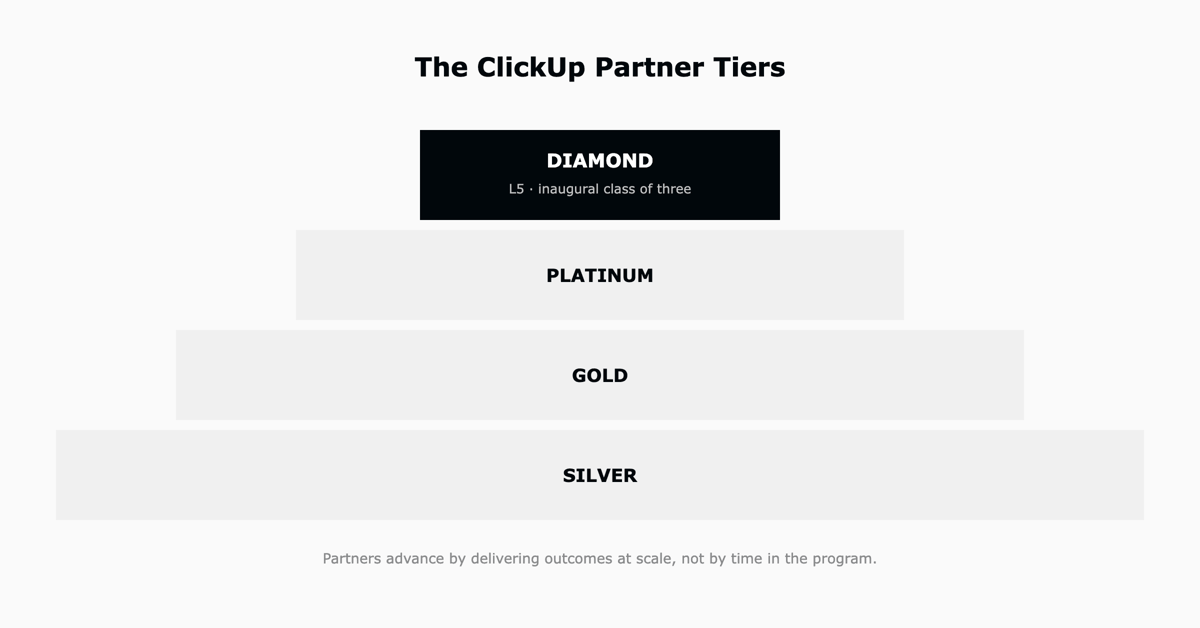
A ClickUp Diamond Partner holds Diamond, the highest tier ClickUp awards. It did not exist until 2023. L5 was part of the inaugural class of three partners when ClickUp created the designation. ClickUp announced it via Business Wire with this from their Chief Business Officer: "To achieve Diamond status is no small feat, and ZenPilot, L5, and Kolme are at the top of their game." ClickUp's own partner directory currently describes L5 as its only global partner.
ClickUp's partner program has four tiers: Silver, Gold, Platinum, and Diamond. Each tier reflects requirements across implementation volume, certification depth, and customer outcomes. Partners advance by delivering more implementations successfully, not by spending more time in the program.
Diamond partners are in the top performance tier across all three dimensions. For a partner with 600+ customers and 100+ recurring Operate subscriptions, the credentials follow from the work. The tier is an outcome of operating at scale, not a precondition for it.
For buyers, the tier is a signal of two things: the partner has done this many times before, and ClickUp has validated the outcomes. Both matter more than a polished sales deck.
Partner tiers are easy to dismiss as internal program mechanics. Three things about Diamond status translate directly into outcomes for the customer engaging L5.
Diamond partners have direct relationships with ClickUp's product and partner teams. When a ClickUp capability is relevant to your environment and you need clarity on how to deploy it correctly, L5 has the access to get that answer without navigating general support. That access shortens resolution time on edge cases that generic partners cannot resolve quickly.
Diamond status reflects implementation volume that ClickUp validates independently. 600+ customers and 100+ recurring Operate subscriptions produced the pattern recognition that ACT codifies. An internal team sees one environment. L5 sees hundreds simultaneously. The configuration problem you will encounter in month three is one L5 has seen and resolved in someone else's environment already. That cross-customer pattern recognition does not exist at lower partner volumes.
Customer satisfaction scores, delivery outcomes, and performance metrics that ClickUp measures independently determine Diamond status. You are not relying on L5's self-assessment of quality. You are relying on ClickUp's assessment, built from the outcomes its own customers reported. That is a different kind of credential than a partner's marketing page.
The most important distinction among ClickUp partners is not the tier. It is what the partner does after go-live.
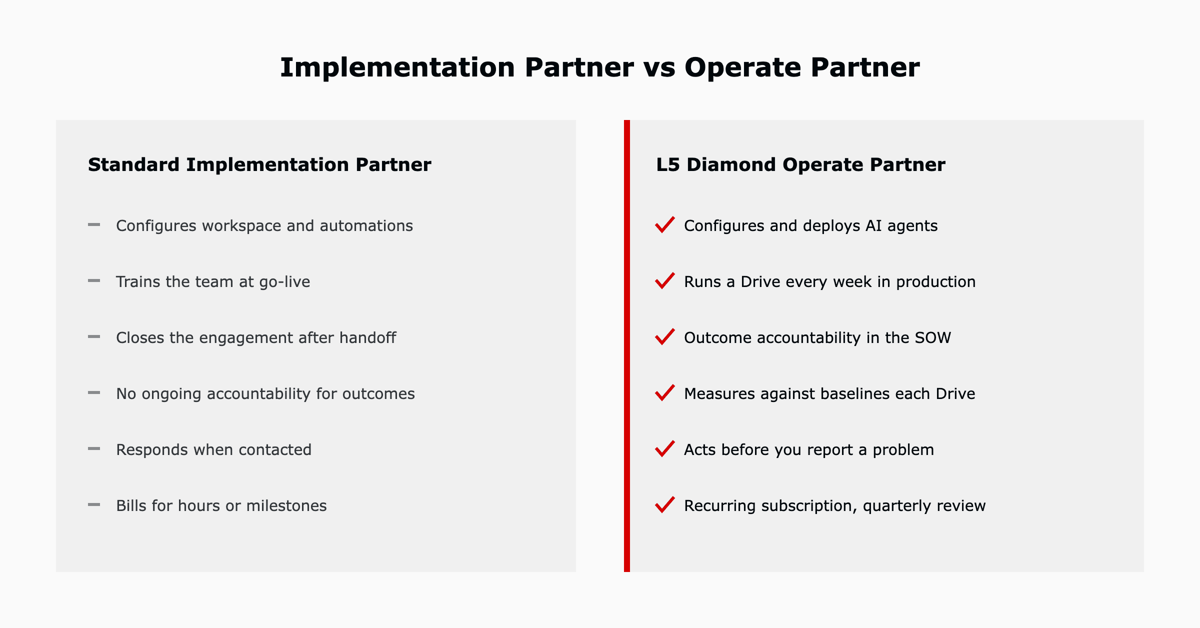
Most ClickUp partners are implementation partners. They configure the workspace, build the initial automations, train the team, and close the engagement at go-live. The handoff is clean. The customer is on their own. What happens to the ClickUp environment in month four is not the partner's responsibility.
A small number of partners operate ClickUp after go-live. They run a recurring engagement: reviewing system performance, maintaining workflow configurations, tuning AI agents, and measuring outcomes against defined baselines. This is a fundamentally different service. It requires a different operating model, a different contract structure, and a different accountability framework.
Before L5 systematized the implementation process, average ClickUp onboarding across the industry was around 55 days. Scope crept. Requirements surfaced late. Testing got compressed. Go-live became a negotiation.
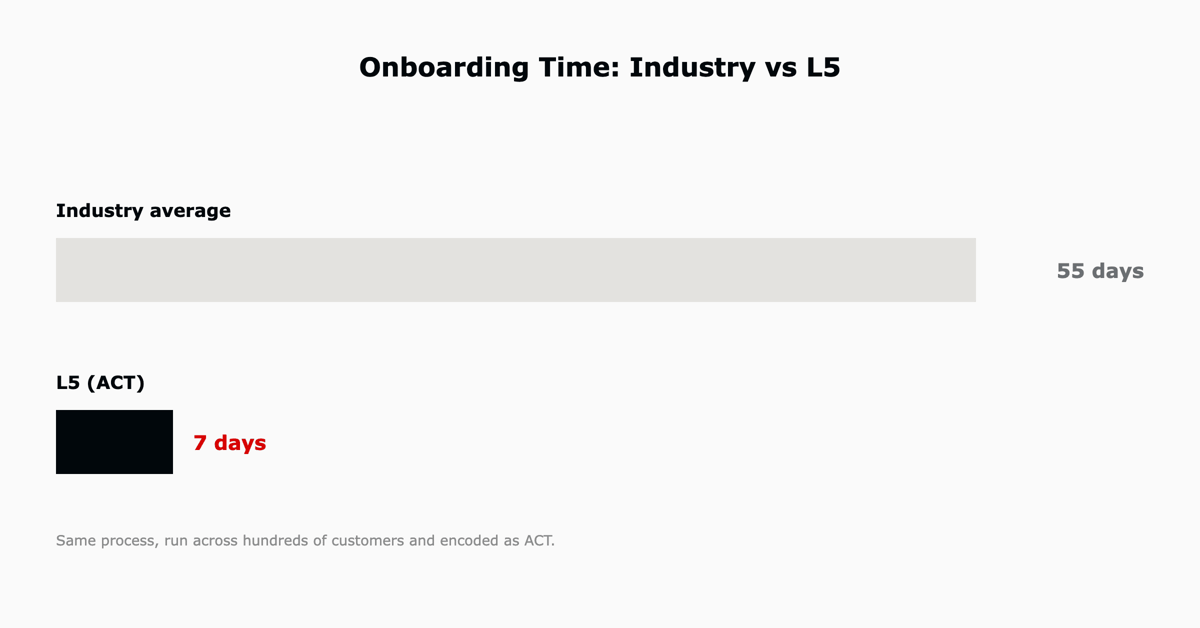
L5 compressed that to 7 days not by cutting corners but by running the same process across hundreds of customers and encoding what worked. The ACT methodology came from that experience. Every Onboard Drive follows five steps: Discover, Realize, Iterate, Validate, Enable. Done is defined before the Drive begins. The Drive ends when the use case is live in production. The next Drive starts from there.
The discipline is what produces the speed. When scope is defined before the Drive begins, there is nothing to negotiate at go-live. When the process is the same every time, the team executing it gets faster with each repetition. When outcomes are defined before work starts, everyone knows what success looks like on day one.
"ACT started as an onboarding methodology for ClickUp. It compressed average onboarding time from 55 days to 7 days. That result did not come from a framework document. It came from running the same process repeatedly across hundreds of customers, observing what worked, and encoding the pattern."
Bipin Paracha, CEO, L5
One credential that is not visible in a partner tier but matters significantly: L5 uses ClickUp internally. Every client engagement is tracked in ClickUp. Every Drive has a backlog in ClickUp. Every outcome is measured in ClickUp. The operating system L5 sells to clients is the same system L5 uses to run its own business.
This creates a compounding depth. The team operating client environments is doing the same work in their own environment every day. Configuration patterns that work internally get applied to client environments. Problems that surface internally get resolved before they surface in client environments. The expertise is operational, not theoretical.
Under 100 people. 600+ customers. The ratio is only possible because L5 applies AI operating discipline internally at the same level it sells to clients.
Before signing an implementation engagement, four questions separate operators from implementers.
An implementation partner will tell you the handoff is complete and support is available if you need it. An Operate partner will tell you that month six is Drive 24 and the backlog for that week is already prioritized.
If the answer is your team, you are getting an implementation. If the answer is the partner, with outcomes written into the SOW and measured after every Drive, you are getting an operator.
Implementation volume tells you how many times a partner has configured ClickUp. Operate subscription volume tells you how many environments they are running right now. These are different numbers and different skills.
The answer reveals whether the partner's expertise is operational or theoretical. An operator who uses the platform every day to run their own business has a different depth than one who uses it for client projects only.
Diamond means the partner has done the work at scale and done it well. What you are buying beyond the tier is the operating model: weekly Drives, outcome accountability, AI agent governance, and a partner who is still running your environment in year two. That is the difference between implemented and operated.
One practical distinction worth understanding before signing any ClickUp partner agreement: the license relationship.
Most ClickUp implementations involve a separate license agreement with ClickUp and a separate services agreement with the partner. Two contracts. Two parties. When something is not working, there are two parties to contact, and the question of whose problem it is creates delay.
L5's Operate subscription includes the ClickUp platform license as part of the contract. One agreement. One party accountable for whether the platform works and whether outcomes are delivered. When something needs to change, the Drive that week addresses it. There is no routing between a platform vendor and a services partner. One contract, one outcome accountability.


The full article with its figures, tables and sources, set for reading offline, printing, and sharing.
On its way to your inbox You can also download it right now.
Download the PDF Last updatedKeep reading
Law firms and solo lawyers use ClickUp as the work layer around a matter: intake, deadlines, document collaboration, bil...
Read
Last verified July 2026. Connecting ClickUp to Make.com takes about five minutes and no code. You create a scenario in M...
Read
ClickUp is a productivity tool. L5 can configure ClickUp to suit the specific needs of various industries, including law...
ReadField notes on AI operations and service management, direct to your inbox. New insights, the week we publish them.
No spam. Unsubscribe any time.