The Autonomous IT Workforce
Whitepaper
How people and AI resolve together on a purpose-built service platform, and who keeps it producing after go-live.
AI is live at most companies and outcomes lag. Gartner predicted that at least 30 percent of generative AI projects would be abandoned after proof of concept by the end of 2025, on poor data quality, weak controls, escalating costs, and unclear value. One study of enterprise deployments found 95 percent of generative AI pilots returning no measurable P&L impact, against a strict test of sustained, documented results.
McKinsey reports 88 percent of organizations using AI in at least one function and 39 percent attributing any EBIT impact to it. Deloitte finds executives under board pressure to justify the spend, with returns arriving in two to four years against a payback they expect in seven to twelve months. The question has changed from whether the company uses AI to what it produces.
The four controls AI needs
A model with no defined job, no governed data, and no owner produces activity. It answers, drafts, and routes, and the request stays open. A purpose-built service platform gives that same model four things it needs to be trusted: a defined job, governed data, guardrails on action, and a resolution loop. The emerging standards for trustworthy AI rest on the same operating principles, from the NIST AI Risk Management Framework to ISO/IEC 42001, both of which put post-deployment monitoring, human oversight, and change management at the center of a governed AI system.
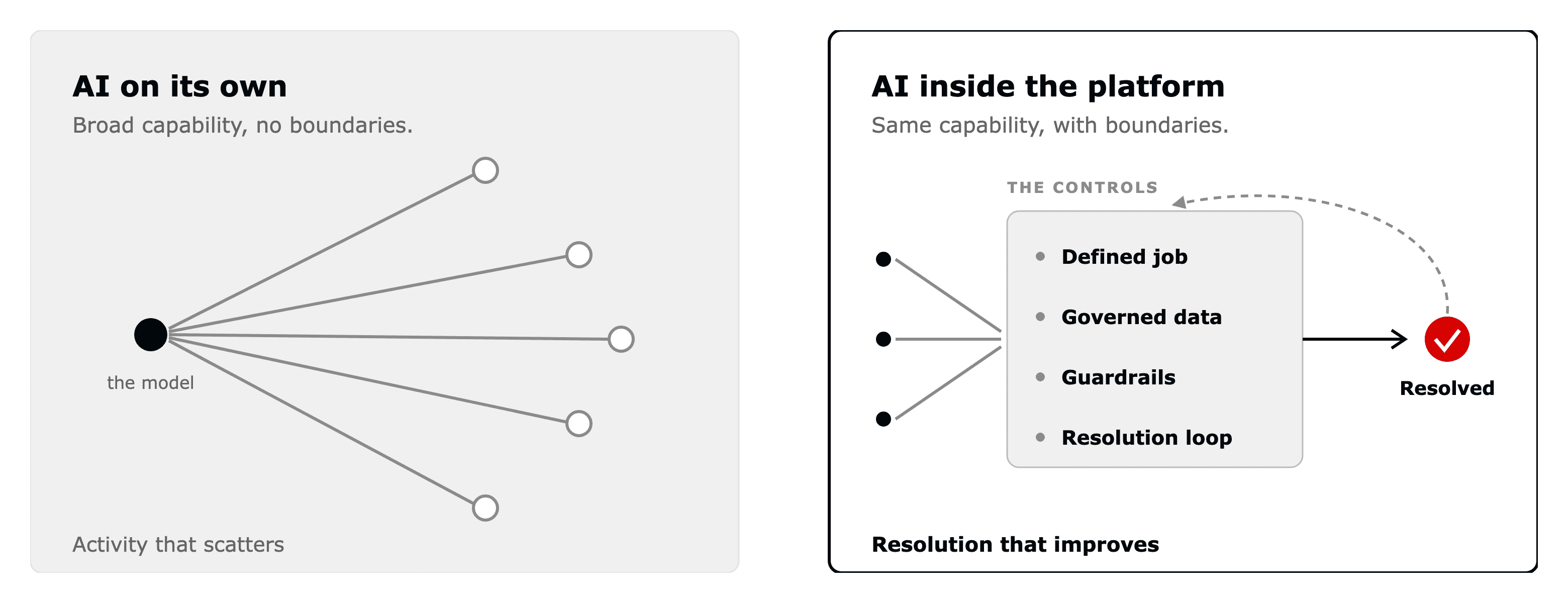
Resolution replaces the closed ticket
A closed ticket is an administrative event. A resolution is a validated outcome that meets defined criteria for quality and completeness. A ticket closed on first contact and reopened the next day reports success while the person is still stuck. Gartner advises service leaders to prioritize resolution over channel choice, and reported in 2019 that only 9 percent of customers solved their issue completely through self-service. That gap is what an autonomous workforce is built to close.
The endpoint and the service desk
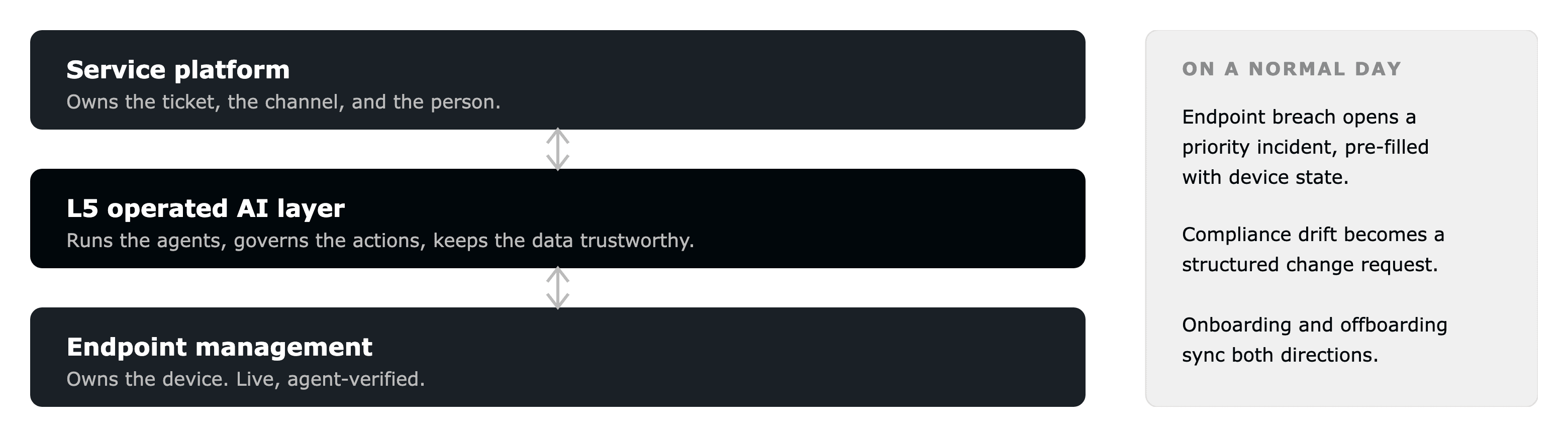
IT service does not stop at the ticket. It reaches the device. Endpoint management owns the device record, live and agent-verified. The service platform owns the ticket and the identity. Neither keeps a second copy of the other, which removes the reconciliation work that makes CMDB projects stall. Gartner has found only about 25 percent of organizations achieve meaningful value from their CMDB, and manual asset records are estimated to run 40 to 60 percent inaccurate within three months.
A connector is a starting line
Connecting the service platform to endpoint management and turning on the agents is a project with a finish date, and a capable team completes it. What the system produces on go-live day is not what it produces a year later. A peer-reviewed study observed temporal degradation in 91 percent of the model and dataset pairs it tested and named the effect AI aging. IBM notes that model accuracy can begin to degrade within days of deployment as production data diverges from training data.
Most organizations stall before Level 5
L5 describes AI maturity for service in five levels: Pilot, Use, Build, Govern, and AI Operated. Fewer than 10 percent of L5's 600 or more customers reach the fifth level without an active operator. Reaching it and staying there takes someone accountable every week for what the AI produces.
How the loop runs
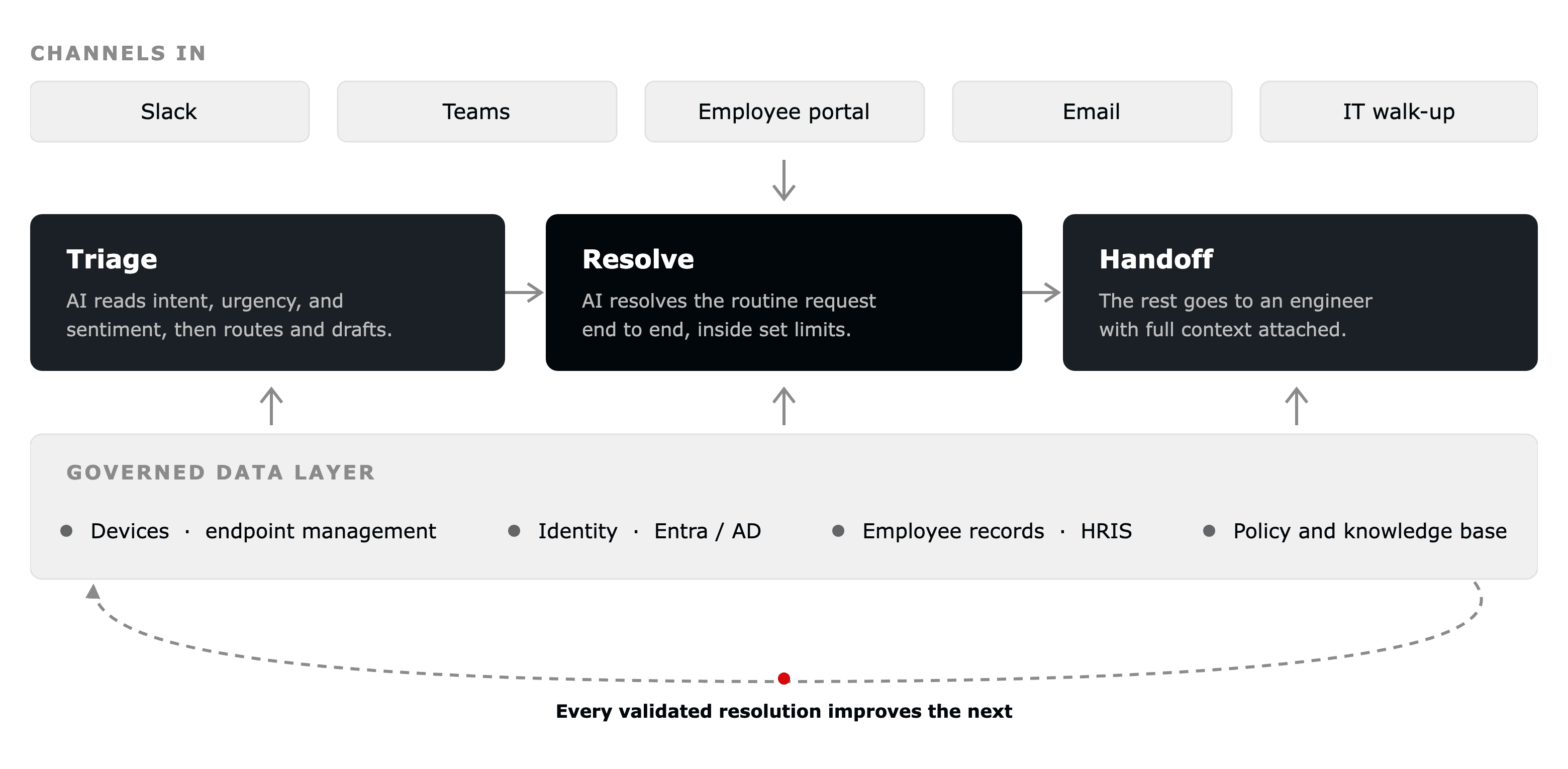
In IT service the loop runs end to end. Requests arrive through Slack, Teams, the employee portal, email, and the walk-up. The AI reads intent, urgency, and sentiment, then routes and drafts a response, drawing on live device records, identity, employee records, and the knowledge base. It resolves the routine request or hands the rest to an engineer with the context already attached.