Legacy Systems Are Holding Back Your AI Strategy
Part of a series. This article is drawn from the L5 white paper on modernizing IT service management, and looks one laye...
ReadCopilot, automation, and autonomous AI get sold as one word. What separates them, and the four controls that keep a deployment resolving after go-live.
 Sanay Tripathi
Part of a series. Why enterprise AI stalls is one article drawn from the L5 whitepaper on how people and AI resolve together, and who keeps a deployment producing after go-live. Download The Autonomous IT Workforce.
Enterprise AI stalls because three different modes of operation get sold and bought as one word. Automation, copilot, and autonomous AI produce different outcomes, and deployments routinely stall at the middle one, no matter what the contract calls it.
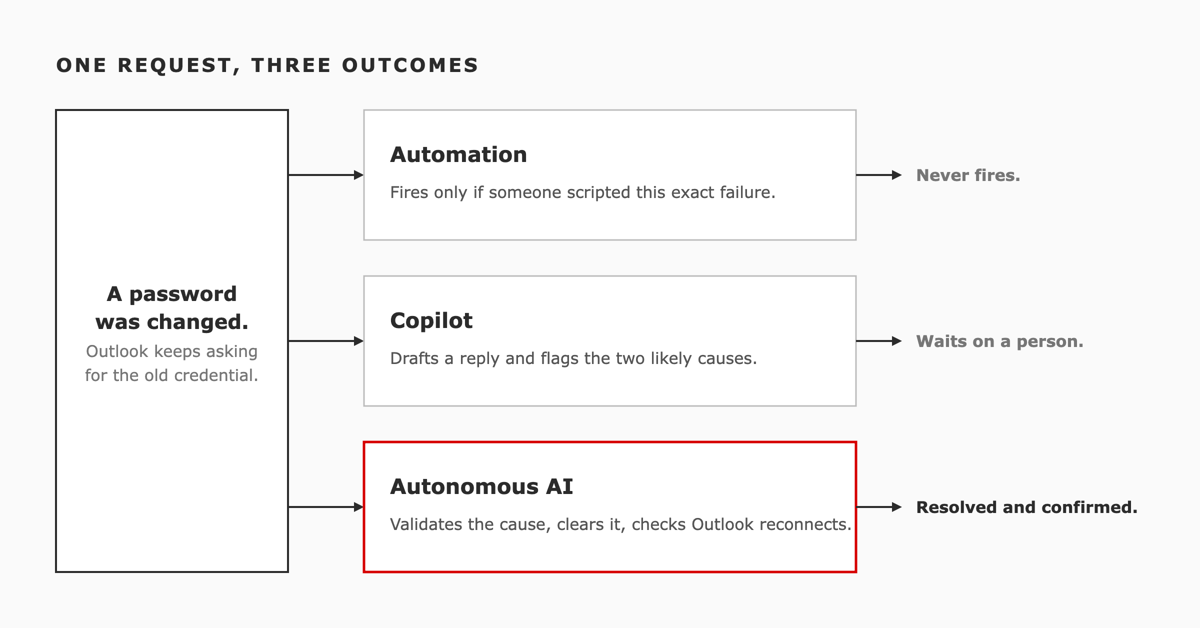
Here is what that confusion looks like on an actual service desk. In one pre-sales engagement, an employee changed a Windows password and immediately started seeing repeated Outlook prompts for the old credential, a mismatch that is common and rarely understood on first contact.
A copilot-style assistant can read that request, match it to known articles about password changes and Outlook re-authentication, and draft a response. It cannot confirm the mismatch is the actual cause, clear the cached credential itself, or verify Outlook reconnects afterward. A person still has to do all three.
An automation rule only fires if someone already anticipated this exact failure and scripted the fix in advance, which is why automation libraries tend to lag the actual pattern of requests.
Autonomous AI is the version that validates the cause against identity data, applies the fix within its guardrails, confirms Outlook is reconnected, and closes the loop, or escalates immediately if any of those steps do not check out.
This is not a niche problem. Deloitte finds executives under board pressure to justify AI spend, with returns arriving in two to four years against a payback window they expect in seven to twelve months. The spend lands long before the outcome does.
Production is where the gap actually sits.
The terms get used interchangeably.
Automation executes a predefined rule against a predefined action. Modern workflow automation can branch, call APIs and react to events, so the limit is not sophistication. The limit is that its decision logic has to be designed in advance, so it only covers the failures somebody already anticipated.
A copilot understands a request and recommends what a person should do next. A person still validates the recommendation and executes it.
Autonomous AI understands a request, validates it against governed data, acts within guardrails, verifies the outcome, and escalates only when the situation calls for judgment. The harder half of that is knowing when to stop, since an autonomous system earns trust by recognising the cases it should hand to a person.
Vendors use these words differently, so to be plain about the terms here: a copilot recommends while a person stays responsible for execution, and autonomous AI carries the request through to a verified outcome. What separates the three modes is who owns the outcome and who executes the action.
| Dimension | Automation | Copilot | Autonomous AI |
|---|---|---|---|
| Ownership of the outcome | Nobody, it follows a rule | The person who acts on the suggestion | The system, within its guardrails |
| Decision-making | None, rule-based | The person decides | The system decides within policy |
| Ability to take action | Yes, but only the scripted action | No, drafts only | Yes, within guardrails |
| Human involvement | Setup only | Every request | Exceptions only |
| Escalation | None | Implicit, the person is already involved | Explicit, with context attached |
| How success is measured | Rule executed or not | Suggestion used or not | Resolution validated or not |
This pattern shows up across the market broadly, regardless of which vendor's assistant sits underneath, including products marketed as autonomous. The technology is usually not the limiting factor. What moves a system from the middle column of that table to the right one is a specific set of controls.
A purpose-built service platform gives that same model four things it needs to be trusted: a defined job, governed data, guardrails on action, and a resolution loop. The platform is not magic. It is where the operational context already lives: identity and device records, permissions, approval paths, workflow state, knowledge, an audit trail, and a route to a human. That is what lets a capable model finish a request instead of describing it. Run the password and Outlook example through all four and the difference stops being abstract.
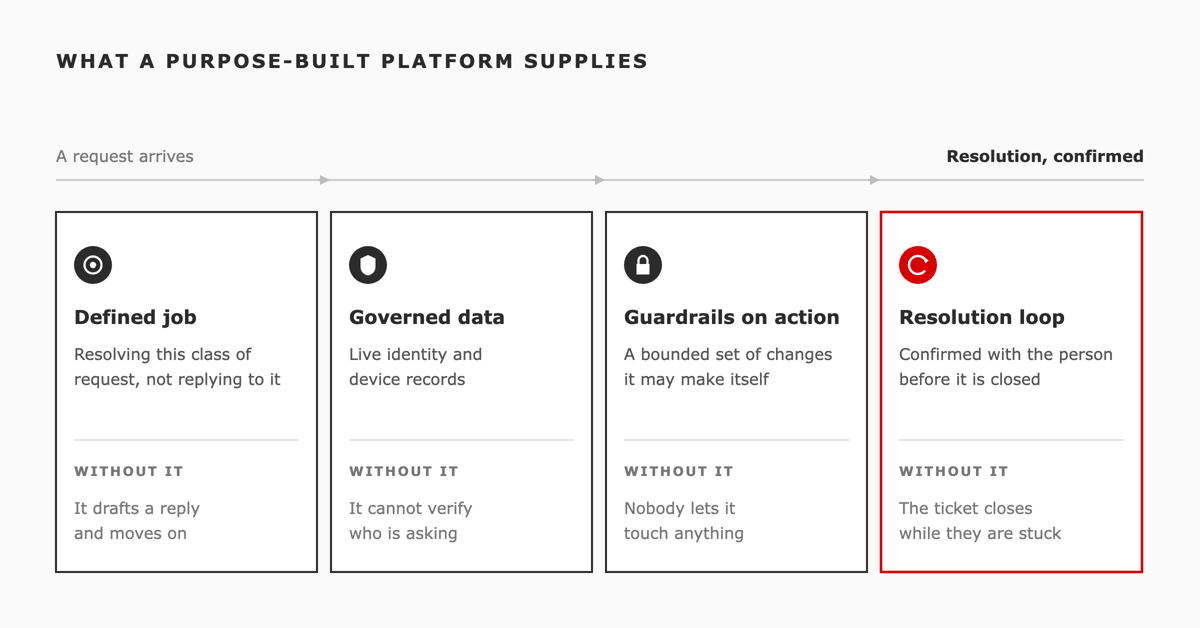
Without a defined job, the assistant treats the request as a drafting task: read it, suggest a reply, move on. With a defined job, resolving that specific class of access issue is what the AI is accountable for, not just responding to it.
Without governed data, the assistant cannot confirm anything about the person or the device asking. With governed data, it can check identity status directly.
In a related endpoint scenario from the same engagement, a complaint about a slow laptop became a specific, verifiable finding the moment the workflow could read the live device record rather than waiting for someone to check it by hand.
Without guardrails on action, nobody will let the system reset a credential or touch Outlook's configuration on its own, and for good reason. With guardrails, it can take that specific, bounded action, and anything outside the boundary still waits for a person.
Without a resolution loop, the ticket can close while the person is still stuck, and nobody finds out until they complain again. With a resolution loop, the fix is confirmed against the person it affected before anything is marked done.
These controls are not new. They line up with the operating principles behind the NIST AI Risk Management Framework and ISO/IEC 42001, both of which put post-deployment monitoring, human oversight, and change management at the center of a governed AI system. That is a more useful test than asking whether a vendor calls something autonomous.
A closed ticket is an administrative event. A resolution is a validated outcome, confirmed with the person it affected, not merely marked done.
Gartner's 2019 research on service economics puts the cost of a live contact at 8.01 dollars against about 0.10 dollars for self-service, and found only 9 percent of customers reporting they solved their issue completely through self-service.
Those figures describe cost and containment. They do not measure whether a resolution actually held, and the industry does not yet have a standard benchmark that does. If cost per resolution is going to replace cost per ticket as a metric that matters, someone has to start measuring reopen rates and resolution validity directly, not infer them from contact-cost figures that were never designed to answer that question.
Until a resolution is confirmed with the person it affected, a closed ticket is only an assumption.
A defined job, governed data, guardrails on action, and a resolution loop get a deployment live. None of it holds still on its own. Models and knowledge drift as the organization changes. A peer-reviewed study observed temporal degradation in 91 percent of the model and dataset pairs it tested, an effect it named AI aging, and IBM notes that accuracy can begin to slip within days of deployment as production data diverges from training data.
Automation meets an edge case nobody tested for. A policy updates, and the guardrails need updating with it. That gap rarely closes by leaving the system alone.
This is the piece most AI deployments are missing: an operator who stays accountable for what the system produces after go-live, every week, rather than a team that gets it connected and moves on.
Across L5's own delivery data, fewer than 10 percent of 600 or more customers reach the fifth level of AI maturity, AI Operated, without an active operator.
The five levels run Pilot, Use, Build, Govern, and AI Operated. Most organizations stall before the fifth.
Once resolution replaces the closed ticket as the unit of value, three metrics are worth building properly.
| Metric | What it measures | Where the number comes from |
|---|---|---|
| Time to productive | How long until the person is working again, across every system the request touched | Clock starts when access is requested and stops when the person is confirmed working, not when a ticket is marked closed |
| Reopen rate | Whether a resolution held | The percentage of resolved requests that come back within a set window, such as seven days |
| Autonomous resolution rate | How much of the routine queue the system finishes end to end | The share of eligible requests resolved without a person and verified as resolved, counted by request type |
Reopen rate is the number that would actually prove whether a resolution held, and building it is worth more right now than citing a figure nobody has yet.
Go back to the Outlook loop. A copilot gets someone to the fix faster. With the four controls in place, the system closes it and confirms it held. The test is whether the resolution actually happened.
A copilot recommends an action and a person executes it. An autonomous AI agent decides, acts within its guardrails, verifies the result, and escalates when it cannot resolve the request safely. The dividing line is who owns the outcome and who executes the action.
No. Automation executes a predefined rule against a predefined action. It does not reason about the request, it follows the script it was given, and it only fires if someone anticipated that exact failure in advance.
A resolution is a validated outcome, confirmed with the person it affected, rather than a ticket marked done. A ticket closed on first contact and reopened the next day reports success while the person is still stuck.
A defined job, governed data, guardrails on action, and a resolution loop. Remove any one of them and the pattern breaks down in a specific, identifiable way.
Most stall at the copilot stage, where the AI recommends and a person still executes. The limit is rarely the model. It is the four controls around it, plus someone accountable after go-live.
Book an assessment and walk away with a scorecard across five levels of AI maturity, a roadmap, and a business case, in one week against a fixed scope. The scorecard shows which of the four controls are already in place and which are missing. L5 deploys and operates AI on purpose-built service management platforms, Zendesk, ClickUp, and Workday, for mid-market organizations, and stays accountable for what the system produces after go-live, every week.
Full citations in The Autonomous IT Workforce, References section.

The full article with its figures, tables and sources, set for reading offline, printing, and sharing.
On its way to your inbox You can also download it right now.
Download the PDF Last updatedKeep reading
Part of a series. This article is drawn from the L5 white paper on modernizing IT service management, and looks one laye...
Read
Part of a series. This article is drawn from the L5 whitepaper on modernizing IT service management, and looks at the mo...
Read
Part of a series. This article is drawn from the L5 whitepaper on how people and AI resolve together, and looks at the l...
ReadField notes on AI operations and service management, direct to your inbox. New insights, the week we publish them.
No spam. Unsubscribe any time.