Why Enterprise AI Stalls, and What Actually Fixes It
Part of a series. Why enterprise AI stalls is one article drawn from the L5 whitepaper on how people and AI resolve toge...
ReadEndpoint management owns the device, the service desk owns the ticket. See how running them as one system gives AI the context to resolve requests.
 Pranshu Ranjan
Part of a series. This article is drawn from the L5 whitepaper on how people and AI resolve together, and looks at the layer under the service desk: the device. Download The Autonomous IT Workforce.
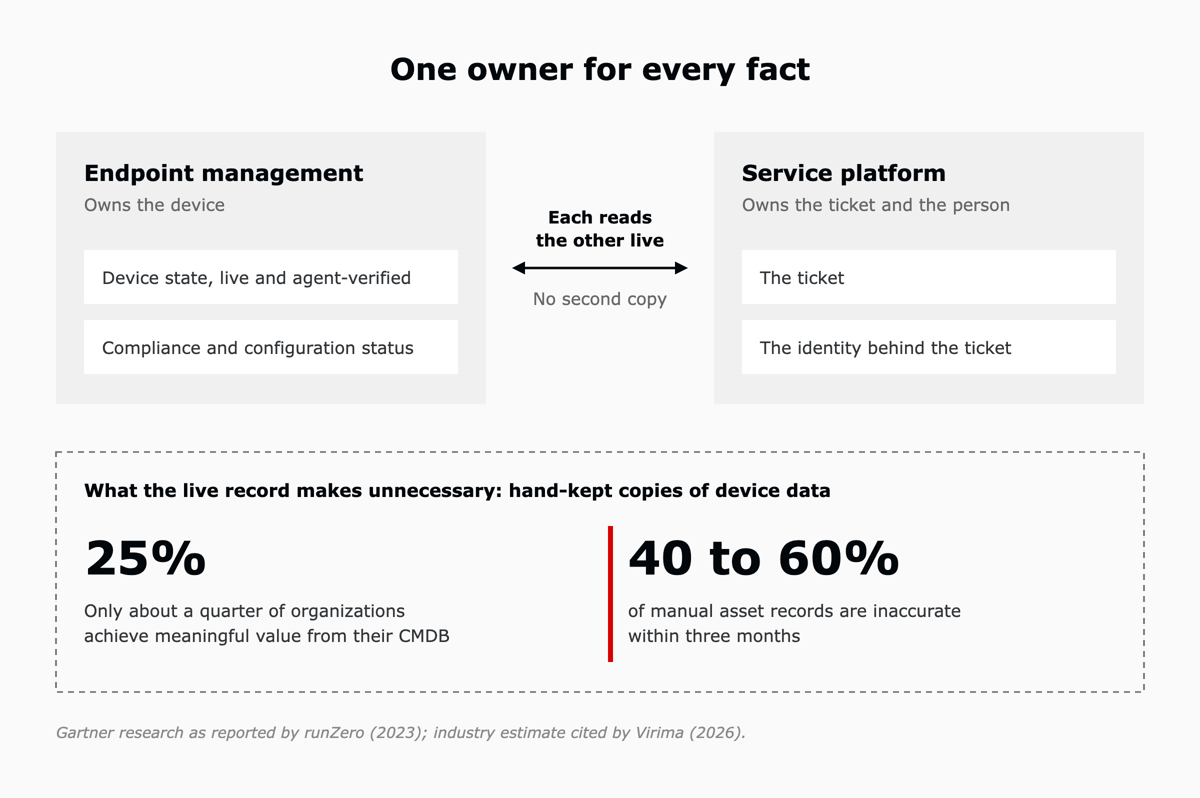
The service desk cannot resolve what it cannot see. The ticket tells it what the employee said, and the endpoint tells it what is actually happening. Endpoint management and the service desk run as one system when each owns the facts it is closest to: endpoint management owns the live device record, and the service platform owns the ticket and the identity behind it. Neither keeps a second copy of the other, and that shared context lets AI resolve a request rather than only respond to it.
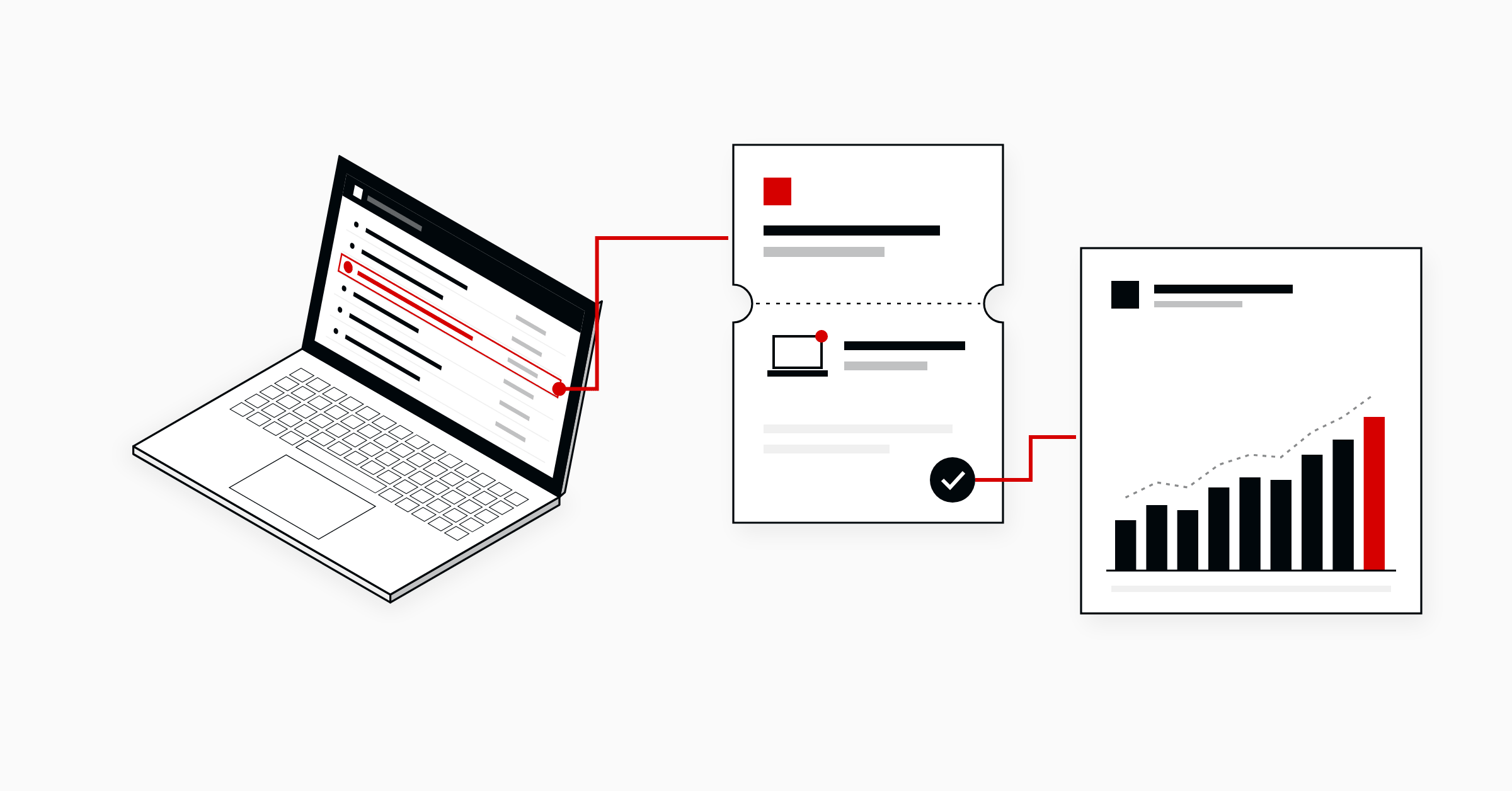
Picture an employee whose laptop cannot reach a critical application. In many organizations the ticket and the device still live in separate systems, with a configuration management database (CMDB) between them holding a copy of device data that is out of date almost as soon as it is created. IT service reaches past the ticket to the device, so the device record has to be right at the moment the request arrives.
The ownership rule is simple. The platform closest to the fact owns the fact.
| What | Owned by |
|---|---|
| Device state, live and agent-verified | Endpoint management |
| Compliance and configuration status | Endpoint management |
| The ticket | Service platform |
| The identity behind the ticket | Service platform |
Neither side keeps a second copy of what the other already knows. A manually maintained copy of device reality becomes unnecessary once a live, agent-verified source reports the same information.
The manual copy is where accuracy breaks down. Analysis from runZero, citing Gartner research, puts the number at about 25 percent of organizations achieving meaningful value from their CMDB. Industry estimates cited by Virima, which sells discovery and CMDB tooling, place manual asset records at 40 to 60 percent inaccurate within three months. A live record does not carry that configuration drift, because it reports the device as it is rather than as it was entered.
In practice that means fewer duplicated records, less time spent reconciling two systems that disagree, and faster decisions once no one has to guess which record is current. A CMDB the team does not trust is one of the gaps that keeps legacy systems holding back AI.
Run as one system, endpoint management and the service platform remove the reconciliation work that used to sit between them. An endpoint breach opens a priority incident, pre-filled with device state. Compliance drift becomes a structured change request instead of a missed alert. Onboarding and offboarding sync in both directions, so one checklist covers both systems.
Walk through one case end to end. An endpoint agent flags a device falling out of compliance. The service platform opens a priority incident automatically, pre-filled with the device state and the person attached to it. The AI reads that context, drafts the remediation, and takes the low-risk steps on its own.
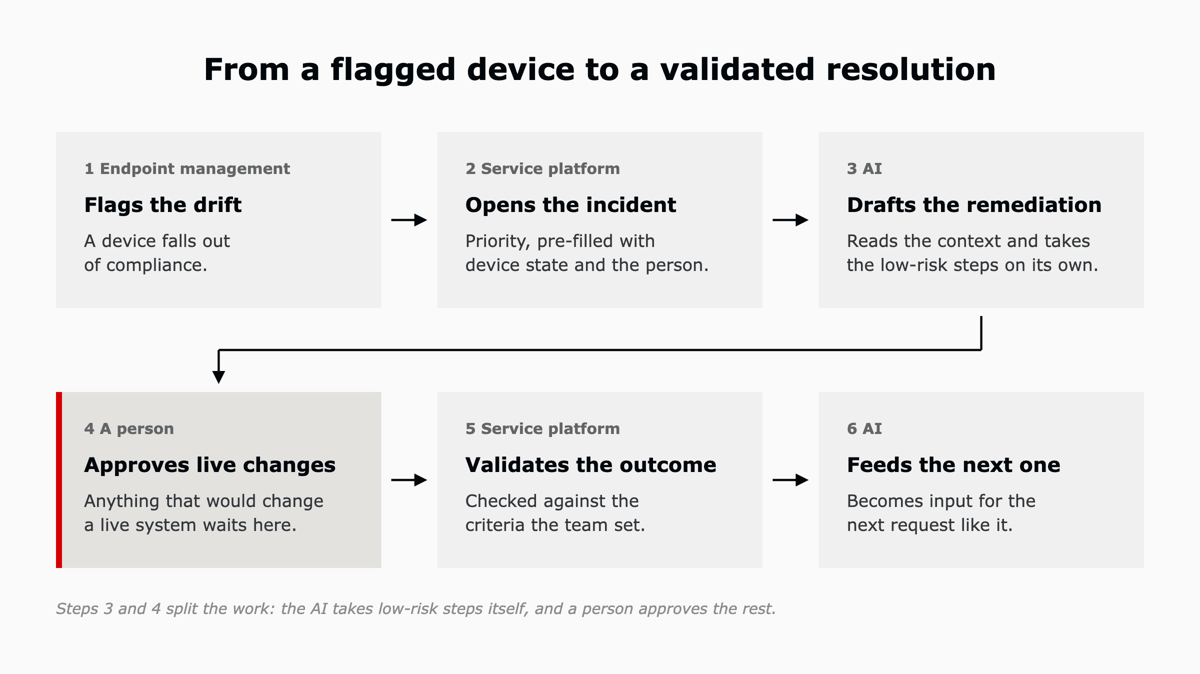
Anything that would change a live system waits for a person to approve. Once resolved, the outcome is validated against the criteria the team set, and that validated resolution becomes input the system uses to handle the next one faster.
Without device context, an AI assistant works from what the employee typed: the VPN is not connecting. With it, the AI works from what is actually true: the device is running an outdated client, sits in a specific network segment, and has already failed the same check twice this week. The difference between those two starting points is the difference between a plausible-sounding answer and a resolved ticket.
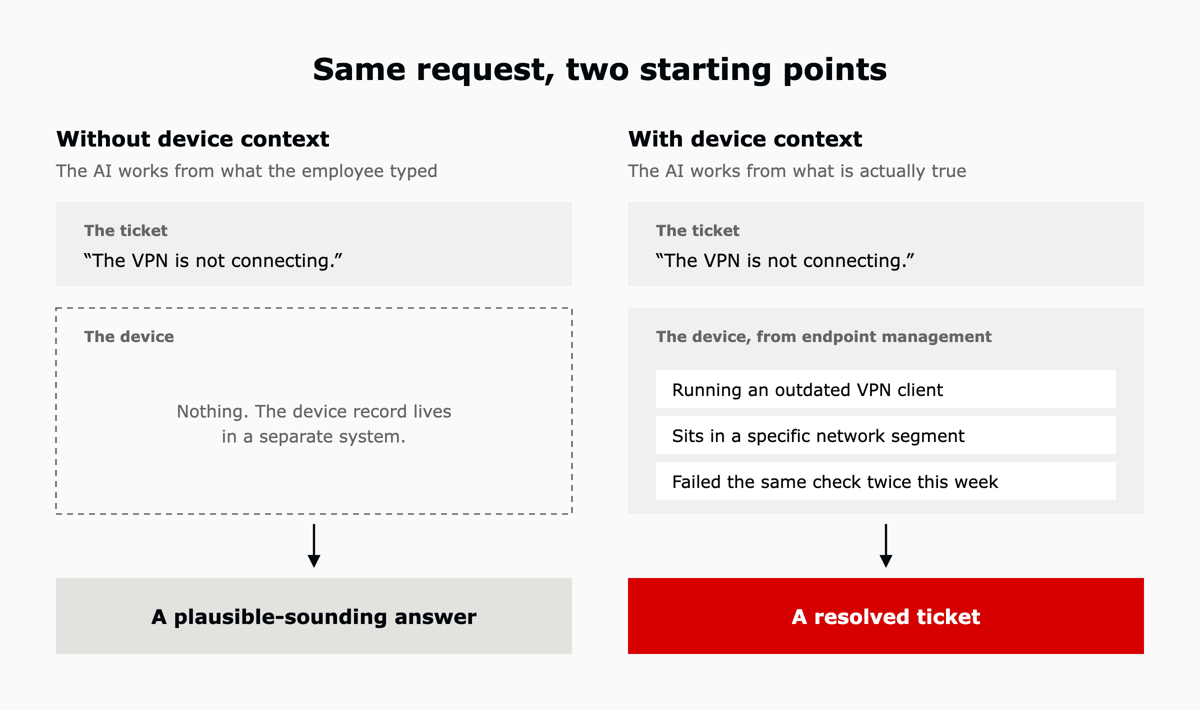
That gap is also the line between a copilot and autonomous AI, the distinction at the center of why enterprise AI stalls. L5 runs this pattern on Zendesk, paired with NinjaOne at the endpoint, and the ownership rule holds for any pairing of an endpoint management tool and a service platform.
The AI takes the routine layer: triage, access resets, status updates, knowledge lookup, and first-draft change requests. People take the work that needs judgment: the sensitive case, the ambiguous incident, the executive escalation.
Live device data becomes service context, and service context is what lets AI resolve routine work with confidence while people focus on the exceptions that actually need them. Account access and password resets, the routine work that dominates a service desk, are the first candidates for this kind of automation.
The handoff matters as much as the split. When a request needs judgment, or reaches an action the AI is not allowed to take on its own, the AI escalates it to a person with the context assembled: the history, the device state, the identity, and what it already tried. The person starts at the decision.
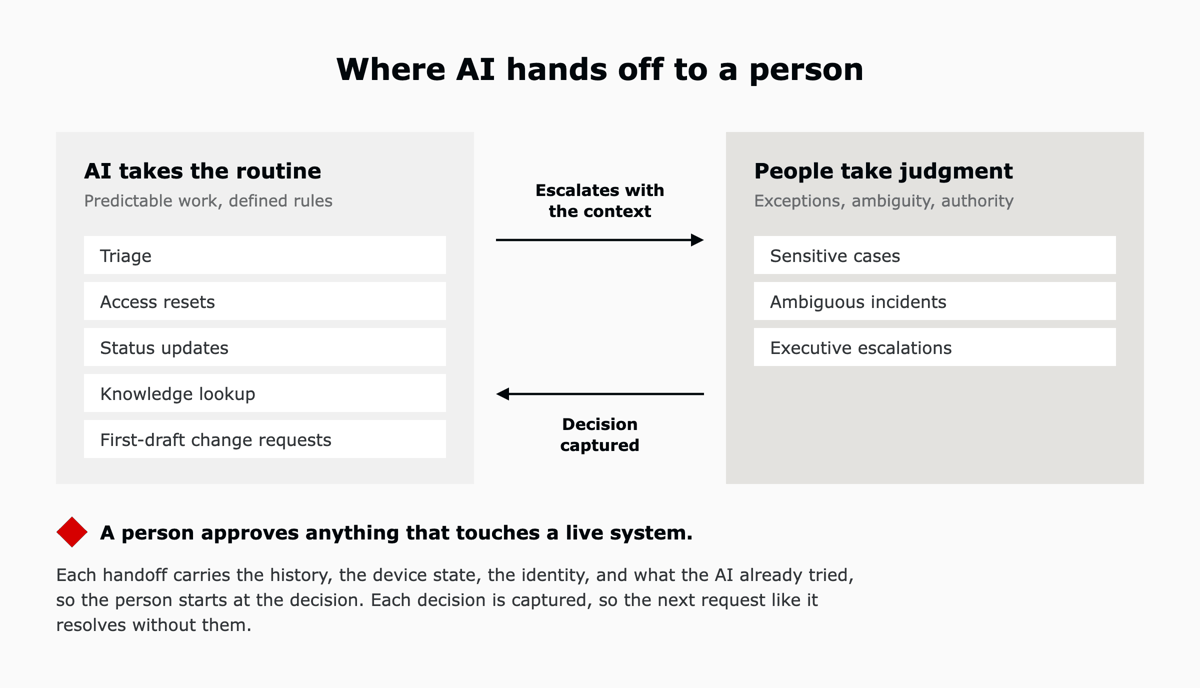
A person approves anything that touches a live system. L5 sets that rule, and regulators apply the same principle where the stakes run higher: the EU AI Act requires that a person be able to override or stop a high-risk AI system in operation. An IT service desk will usually sit outside that classification, so the approval rule is L5 practice that the regulation supports by analogy.
The person's decision does not disappear once the request closes. It is captured, so the next request like it resolves without them, and the system gets a little better at the judgment call every time a person makes one.
Connecting the service platform to endpoint management and turning on the agents is a project. It has a scope, a plan, and a finish date, and a capable team can complete it. The harder question is what the system produces a year later.
Left alone, a connected system decays, and researchers have measured the decay. A peer-reviewed study observed temporal degradation, which it named AI aging, in 91 percent of the model and dataset pairs it tested. AI aging describes a model's performance declining over time as the world it operates in changes around it.
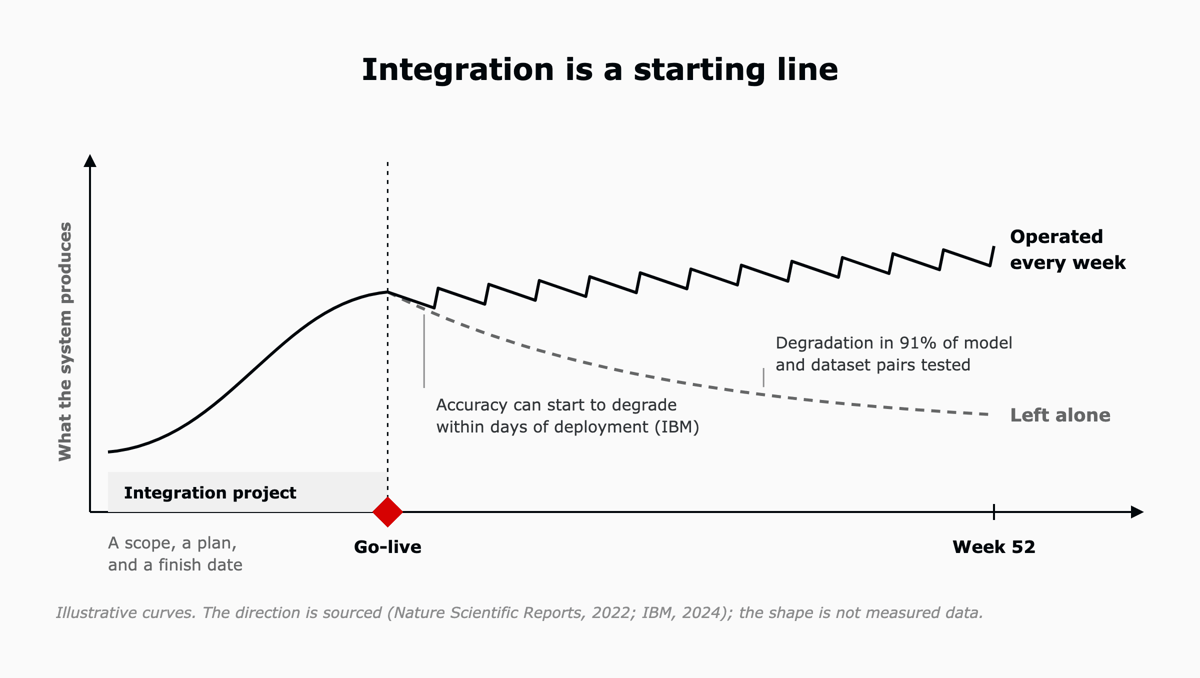
IBM notes that model accuracy can begin to degrade within days of deployment as production data diverges from training data. Models decay at different rates, but the direction is the same: production data keeps moving after go-live, so the system has to be checked and corrected every week.
Several kinds of firm can build the connector. What varies is who stays accountable for outcomes once the project ends.
| Provider model | What it delivers | After go-live |
|---|---|---|
| System integrator | Configures the platform against a fixed scope | Statement of work closes at go-live |
| Managed service provider | Works the ticket queue as requests arrive | Reactive, billed by activity |
| Vendor professional services | Implements and customizes the product | Engagement ends, and each new requirement opens a new request |
| L5 | Operates the AI every week against outcomes committed in the SOW | Still running Drives in week 52 |
Cost per resolution and time to productive for new hires are the two measures most likely to move once resolution replaces the closed ticket as the unit of value. Neither has an industry-standard benchmark yet for this architecture, which is a reason to build the measurement before assuming the business case.
Connecting the systems and operating them are separate jobs. On L5's five levels of AI maturity, an organization can reach wide adoption and still lack governance, or reach governance with no one assigned to correct drift when it appears. Fewer than 10 percent of L5's 600+ customers reach the fifth level, AI Operated, without an active operator, and finding and closing that drift every week is the operator's work.
No. The model works alongside an existing CMDB. What changes is whether a manually maintained copy still has to do the work once a live, agent-verified source reports the same information.
No. The ownership rule applies to any endpoint management tool paired with a service platform. NinjaOne paired with Zendesk is the implementation L5 runs and the example used in this piece.
Connecting them is a project with a scope and a finish date. Operating them is the ongoing work of keeping the connection accurate and the resolutions valid, on a weekly cadence, for as long as the system runs.
Connecting the systems is typically the fast part. Producing validated resolutions week after week is the part that takes continued attention, since production data and request patterns keep moving after go-live.
The full architecture, the maturity model and the operator model L5 runs to keep this system producing after go-live are in The Autonomous IT Workforce. To see where your own service desk and endpoint data stand today, book an assessment and walk away with a scorecard across five levels of AI maturity, a roadmap, and a business case, in one week against a fixed scope.
L5 deploys and operates AI on purpose-built service management platforms, Zendesk, ClickUp, and Workday, for mid-market organizations, and stays accountable for what the system produces after go-live, every week.
Keep reading
Part of a series. Why enterprise AI stalls is one article drawn from the L5 whitepaper on how people and AI resolve toge...
Read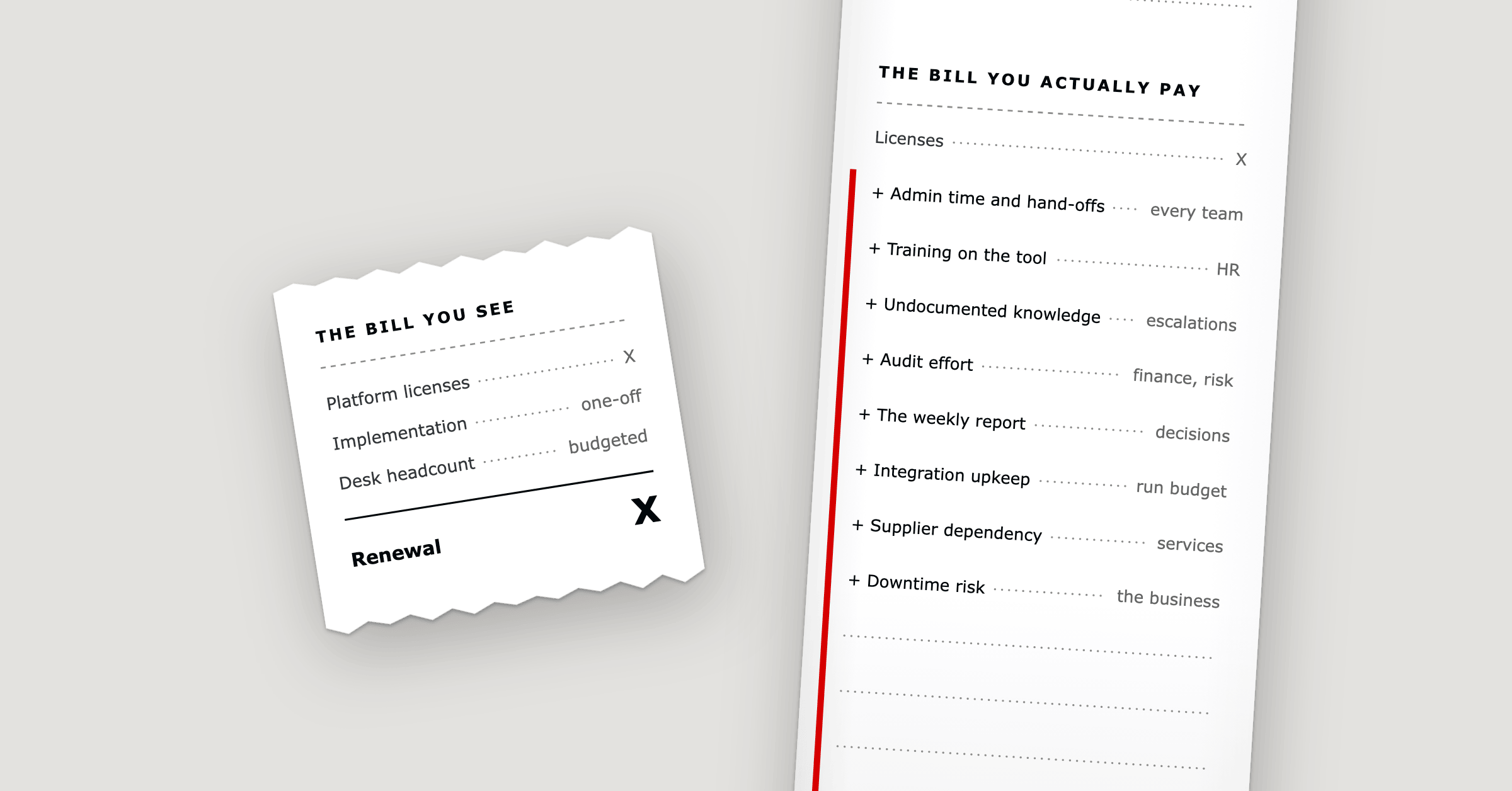
Part of a series. This article is drawn from the L5 white paper on what a fragmented service portfolio really costs to r...
Read
In today’s fast-paced work environment, efficiency is key. ClickUp’s automation features can help streamline your workfl...
ReadField notes on AI operations and service management, direct to your inbox. New insights, the week we publish them.
No spam. Unsubscribe any time.