30 Zendesk Questions, Answered
Zendesk is a customer service platform that teams use to handle support tickets, conversations, and self-service in one ...
ReadWhat a Zendesk implementation covers, what managed services add after go-live, and how to tell which one your team needs.
 L5 Team
Zendesk implementation, sometimes sold as implementation services or Zendesk consulting, is the work of configuring Zendesk around how a team actually works: ticketing, routing, SLAs, the help center, AI agents, and integrations. Managed services are what keep it working after go-live, tuning automations and AI, maintaining the help center, and holding the platform to measurable outcomes week after week. On the AI side that work is the cycle around Zendesk's Resolution Learning Loop. For most mid-market teams the two together, implement and then operate, are what turn Zendesk from a first setup into a support operation that keeps getting better.
A Zendesk implementation is more than turning the product on. It is the set of configuration decisions that decide whether the platform reflects how your team works or fights it. A complete implementation covers the components below, set up in the right order.
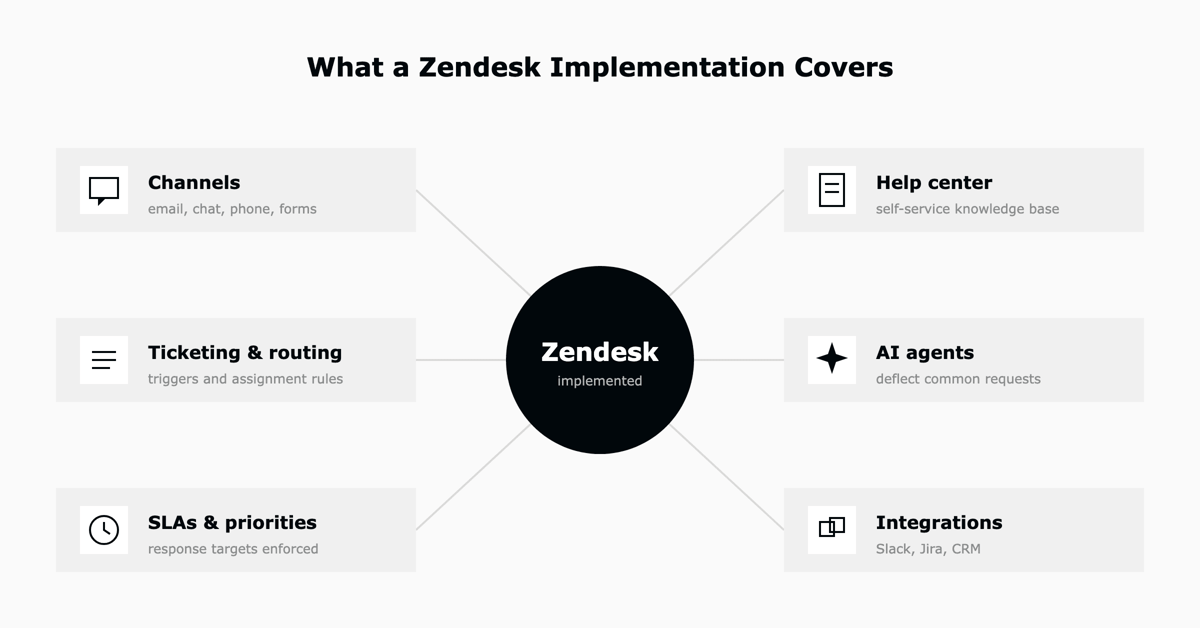
Email, chat and messaging, phone, and web forms brought into one queue so every request becomes a ticket.
Triggers, automations, and assignment rules that get each ticket to the right agent or team without manual sorting.
Response and resolution targets defined and enforced, so nothing quietly ages past its deadline.
A structured knowledge base that powers self-service and feeds the AI agents.
Automated resolution of common requests, configured against the help center to deflect tickets before they reach a person.
Connections to the tools the team already uses, such as Slack, Jira, and a CRM, so context follows the ticket.
Dashboards in Explore that show volume, resolution time, SLA attainment, and where automation would help most.
Go-live is the start of the work, not the end of it. Ticket patterns change, the help center needs new articles, and AI agents need tuning as new questions appear. Zendesk managed services keep all of this current on a recurring cadence rather than letting the setup drift.
The two are different services with different value. Implementation gets Zendesk live and correct. Managed services keep it that way and push it forward. Most teams need both, but many buy only the first and wonder why results stall a few months later.
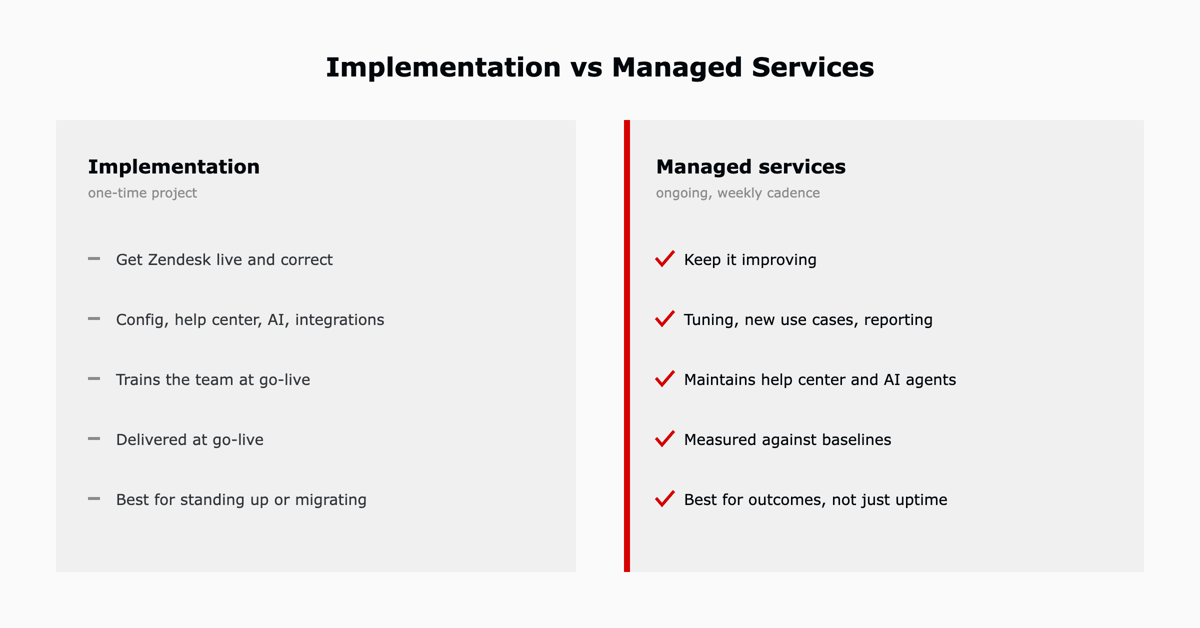
| Implementation | Managed services | |
|---|---|---|
| Goal | Get Zendesk live and correct | Keep it improving |
| Timeline | One-time project | Ongoing, weekly cadence |
| Scope | Config, help center, AI, integrations | Tuning, new use cases, reporting |
| Accountability | Delivered at go-live | Measured against baselines |
| Best for | Standing up or migrating | Teams that want outcomes, not just uptime |
Enterprises can staff a dedicated Zendesk admin team. Small teams can often run a simple instance themselves. Mid-market teams sit in between: enough volume and complexity to need Zendesk configured and operated well, without the headcount to dedicate a specialist to it full time. A managed partner fills that gap, bringing patterns from many Zendesk environments and staying accountable for outcomes rather than billing by the hour. This is where Zendesk consulting and implementation services earn their keep: a good Zendesk consultant does not just advise, they deliver the setup and then operate it against real targets.
Key takeaway. Implementation decides whether Zendesk starts well. Managed services decide whether it stays good. For mid-market teams, the combination is what protects the investment and keeps deflection and SLA performance climbing.
Not every Zendesk implementation partner works the same way. A few things separate a partner who leaves you with a working instance from one who leaves you with a support operation that keeps improving. Look for:
Experience importing tickets, users, and a help center from your current tool without losing history.
Thoughtful triggers, automations, macros, and SLAs, not just the defaults.
Configuring Zendesk AI agents against a real help center so deflection actually happens.
Testing in a sandbox and rolling out one team at a time rather than a big-bang launch.
A clear plan for who tunes and improves the platform once the project ends.
The same rigor applies whether the goal is customer support, IT service management, or HR service delivery.
L5 implements and operates Zendesk AI for IT and HR service management. We configure the platform around how a team actually works, then run it on a weekly cadence with outcomes defined up front, so the system keeps improving instead of drifting. It is the same operate model L5 applies across the platforms it runs, focused on measurable service outcomes rather than a one-time handoff. For the questions buyers ask most, see our 30 Zendesk questions, answered, and how L5 pairs Zendesk with endpoint management in Zendesk, NinjaOne, and L5.

Zendesk implementation is the work of configuring Zendesk around a team's workflow: setting up channels, ticketing and routing, SLAs, the help center, AI agents, and integrations, then training the team. Done well, the platform reflects how the team works rather than forcing a generic setup.
Zendesk managed services are the ongoing operation of Zendesk after go-live: reviewing performance, tuning automations and AI agents, maintaining the help center, and measuring outcomes on a recurring cadence. They keep the platform improving instead of drifting once the initial project ends.
Implementation is a one-time project that gets Zendesk live and correct. Managed services are the ongoing work that keeps it current and pushes deflection, resolution time, and SLA performance forward. Implementation starts the platform well; managed services keep it that way.
It depends on channels, integrations, and how much automation is in scope. A focused rollout can go live quickly when outcomes are defined up front, while enterprise migrations take longer. Defining scope before the build is what keeps the timeline short.
Mid-market teams have enough volume and complexity to need Zendesk configured and operated well, but rarely the headcount for a full-time specialist. A managed partner brings patterns from many environments and stays accountable for outcomes, which is usually faster and more reliable than doing it in-house.
A Zendesk consultant advises on configuring and using Zendesk for a team's goals, from workflow and automation to AI and reporting. The most valuable consultants go beyond advice: they deliver the implementation and then operate the platform against measurable outcomes, closer to a managed service than a one-time consulting engagement.

The full article with its figures, tables and sources, set for reading offline, printing, and sharing.
On its way to your inbox You can also download it right now.
Download the PDF Last updatedKeep reading
Zendesk is a customer service platform that teams use to handle support tickets, conversations, and self-service in one ...
Read
Resolution Learning Loop™ is Zendesk's term for the way its platform learns from every interaction and applies that lear...
Read
Nobody writes a post-mortem for a slowly declining deflection rate. There is no incident when an AI agent's routing accu...
ReadField notes on AI operations and service management, direct to your inbox. New insights, the week we publish them.
No spam. Unsubscribe any time.