Why Enterprise AI Stalls, and What Actually Fixes It
Part of a series. Why enterprise AI stalls is one article drawn from the L5 whitepaper on how people and AI resolve toge...
ReadLegacy systems cap service desk AI at copilot. See the three foundations AI needs, where legacy weakens each one, and a phased fix that adds AI last.
 Divyansh Agrawal
Part of a series. This article is drawn from the L5 white paper on modernizing IT service management, and looks one layer below why enterprise AI stalls, at the service stack AI runs on. Download Modernizing IT Service Management.
Legacy systems hold back an AI strategy because AI in service operations has to act through APIs, see the whole request across systems, and learn from clean history, and legacy service tools weaken all three. Most AI strategies stall well before the limits of the model, at the ten-year-old ticketing tool, the three systems an agent has to swivel between, and the change records nobody trusts.
Picture IT requests running on a home-grown tracker built in a reporting tool, capped at 5,000 items, so the team has to purge old tickets to keep it running. Ask an AI assistant on that stack whether an issue has happened before, and the honest answer is that nobody kept the history. That pattern is what this article is about, and it shows up in the total cost of owning an ITSM platform as well.
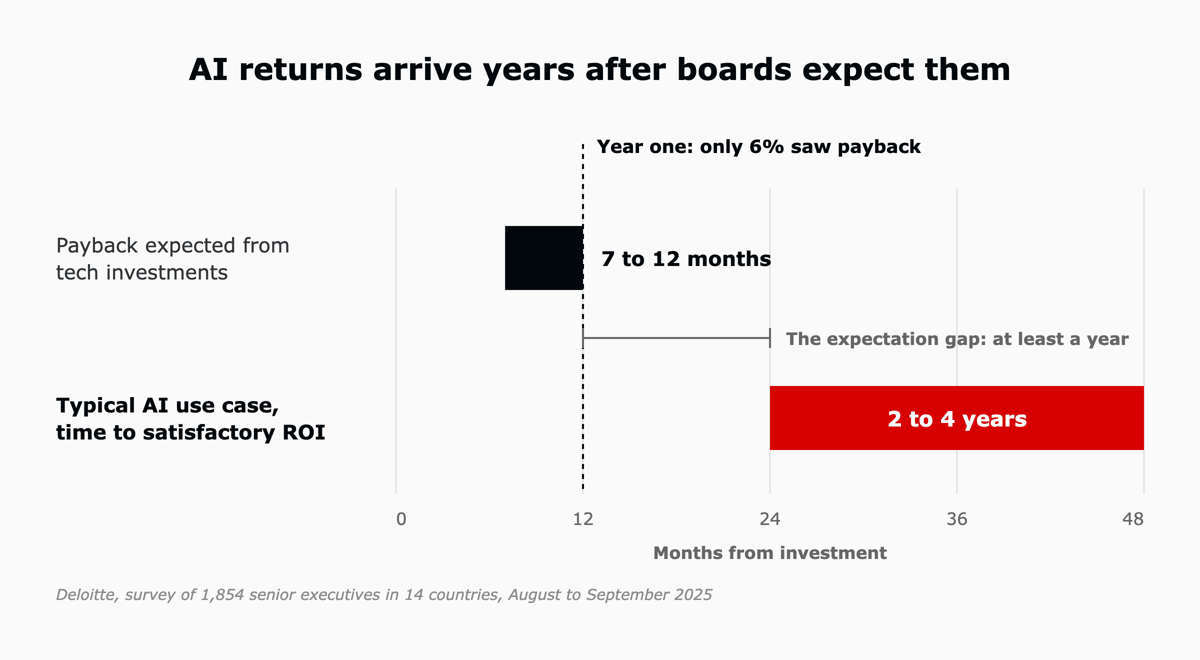
AI budgets are rising. Yet in Deloitte's 2026 survey of 501 U.S. leaders at organizations already piloting agentic AI, only 5% said their business processes were highly prepared for AI agents. When those leaders named what stands in the way, they named data, trust and integration.
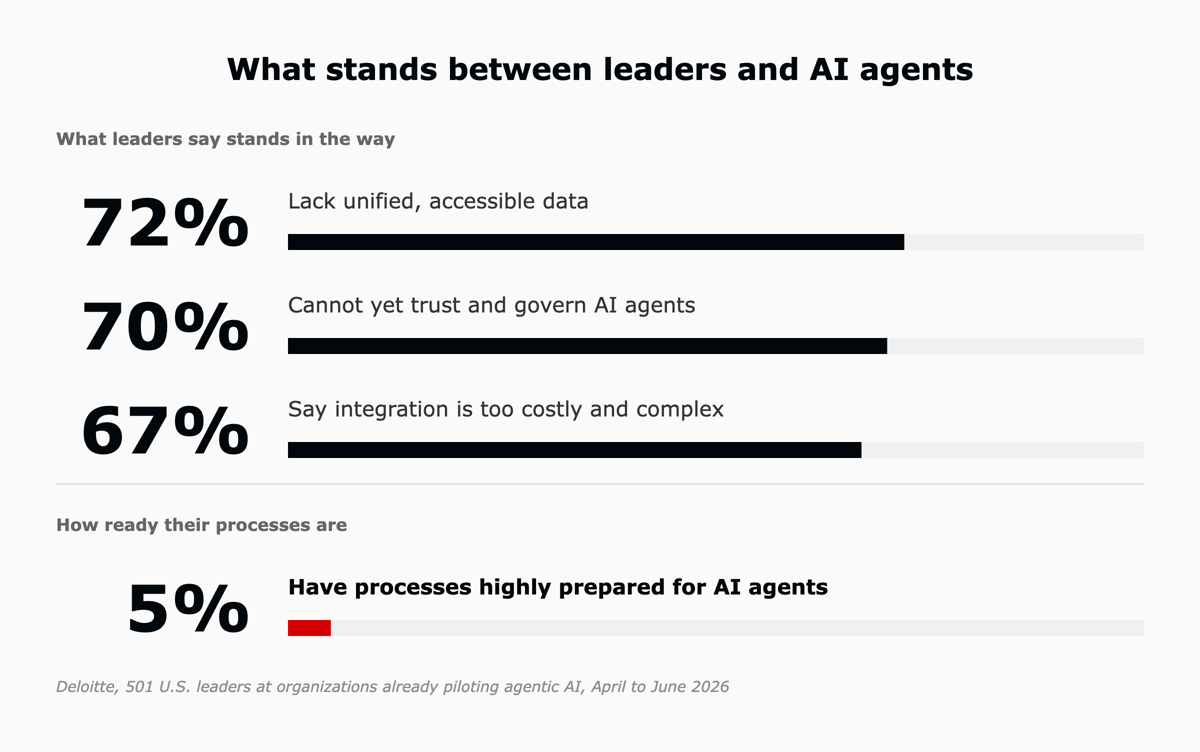
The payback math makes it worse. Deloitte's 2025 survey of 1,854 senior executives found that a typical AI use case takes two to four years to reach satisfactory ROI, against the seven to twelve months expected of technology investments. Only 6% saw payback within a year, and every month spent working around legacy pushes that date further out.
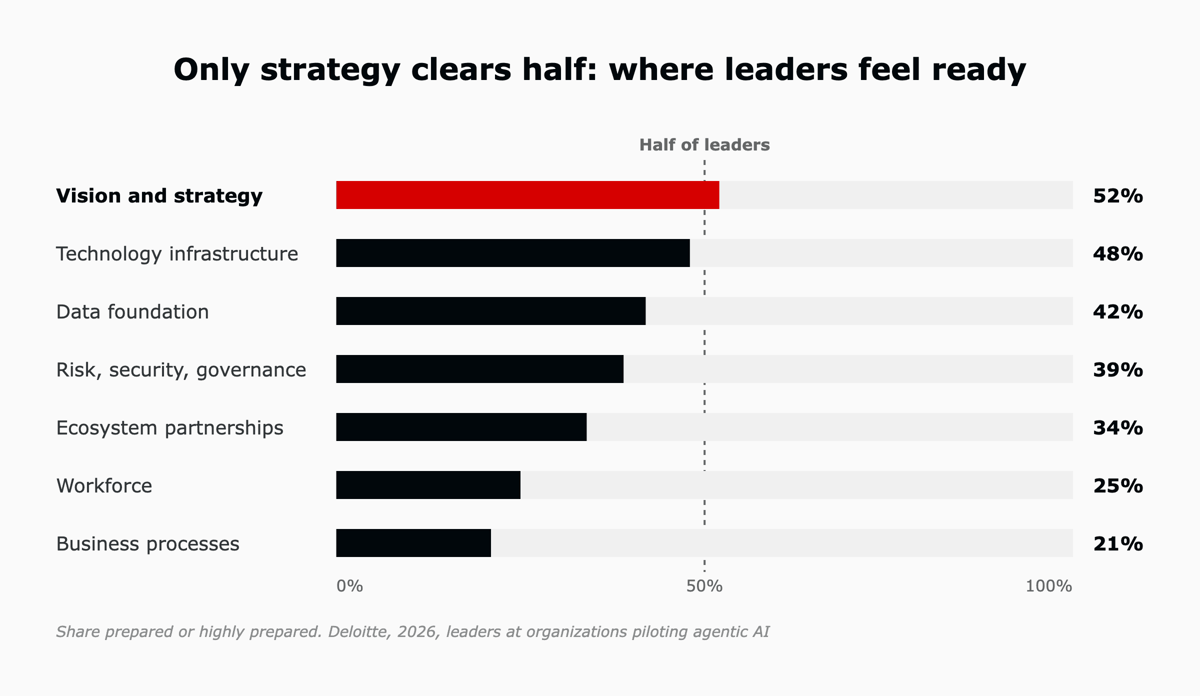
Preparedness tells the same story. Vision and strategy is the only area where more than half of leaders feel ready, and the foundations agents actually run on all trail it.
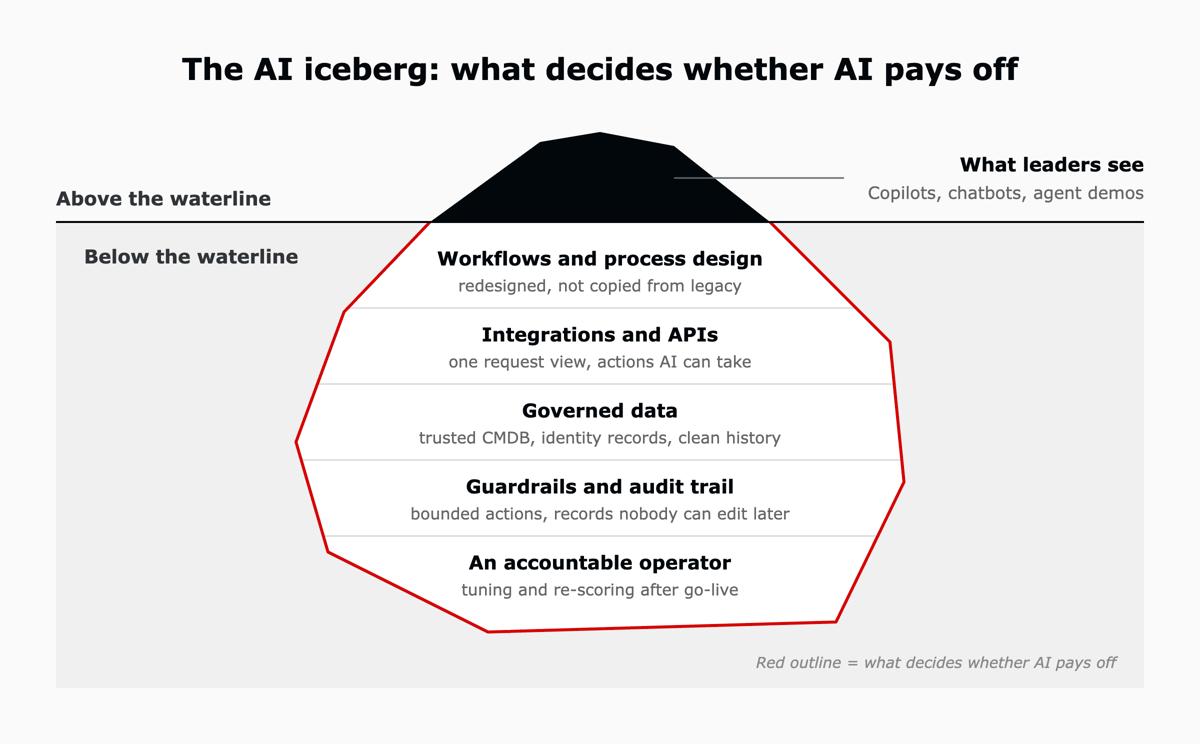
What leaders see is the AI layer. What decides whether it pays off sits below the waterline, in a service stack most organizations have not touched in years.
AI in service operations has to act, see the whole request, and learn from clean history. Legacy weakens each of these in a different way, and underneath all three sit undocumented processes that AI can copy but never fix.
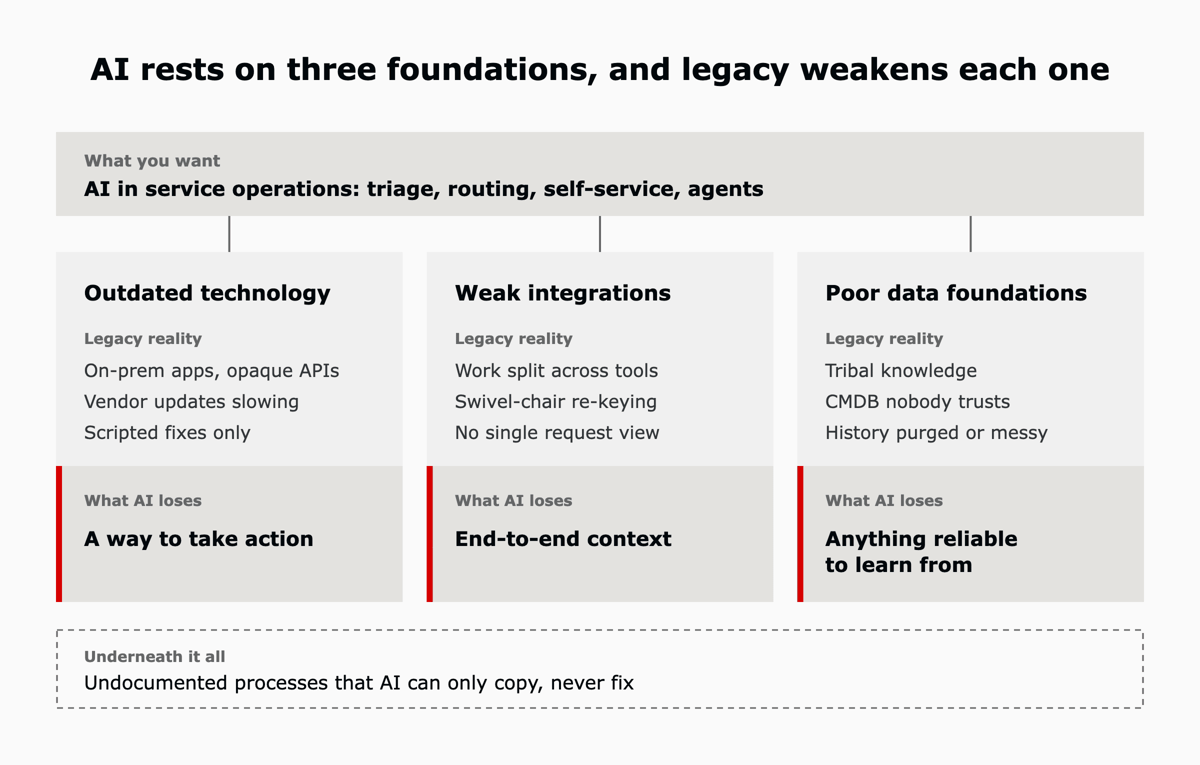
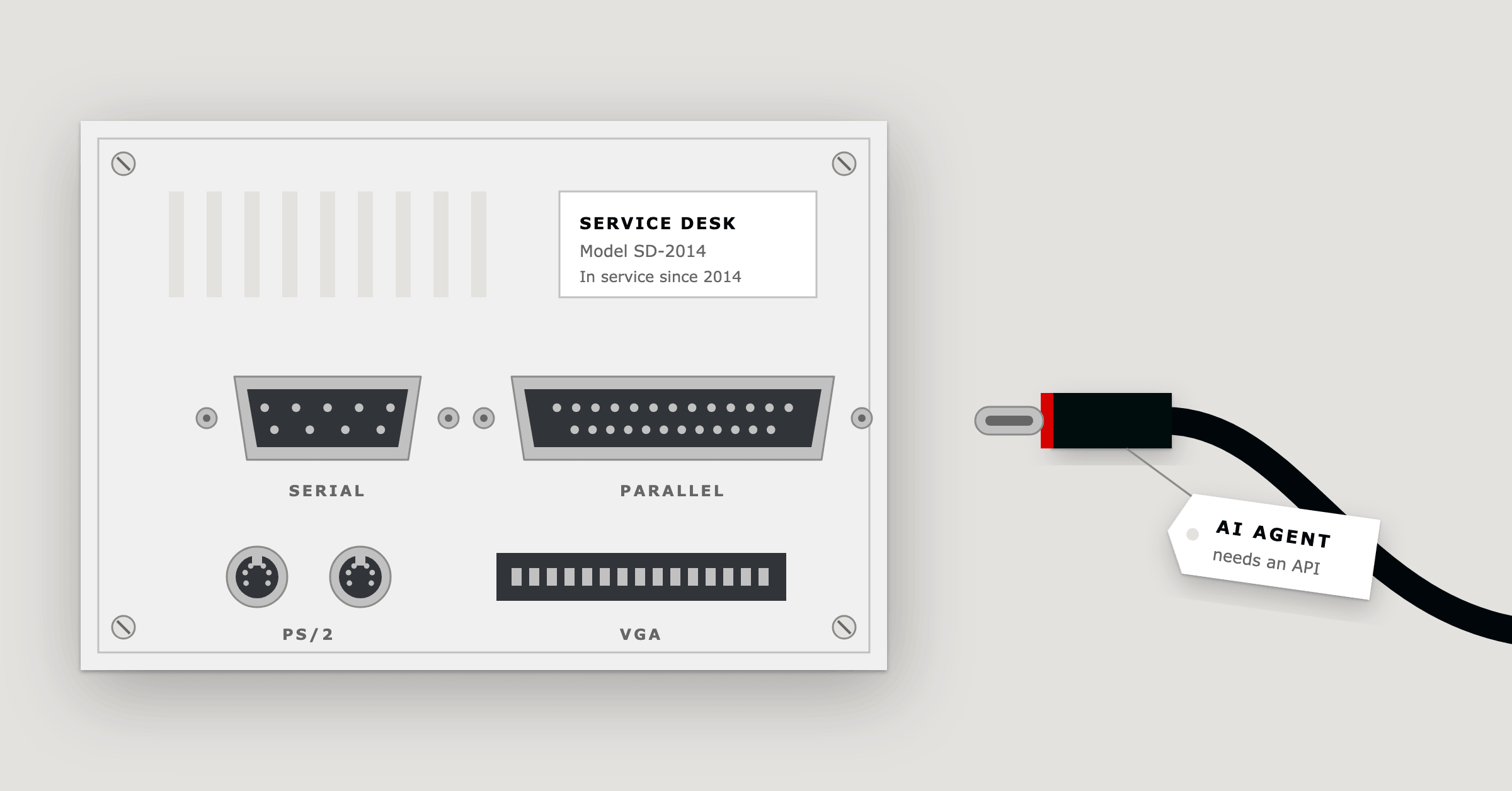
The useful AI actions on a service desk, such as opening, routing, approving and resetting, run through an API. In Saritasa's 2025 survey, 62% of U.S. IT professionals said their company still uses at least one legacy system, and 41% of those companies name incompatibility with modern tools or systems as a top problem. In Salesforce's 2026 benchmark of 1,050 IT leaders across nine countries, 37% call legacy infrastructure or system incompatibility a primary challenge for agentic AI.
"It technically has an API, but you can never figure out how it works."
A financial services client, on its on-prem change tool
AI can only reason over what it can reach. The average enterprise now runs 957 applications, and 86% of IT leaders worry that agents will add more complexity than value without proper integration.
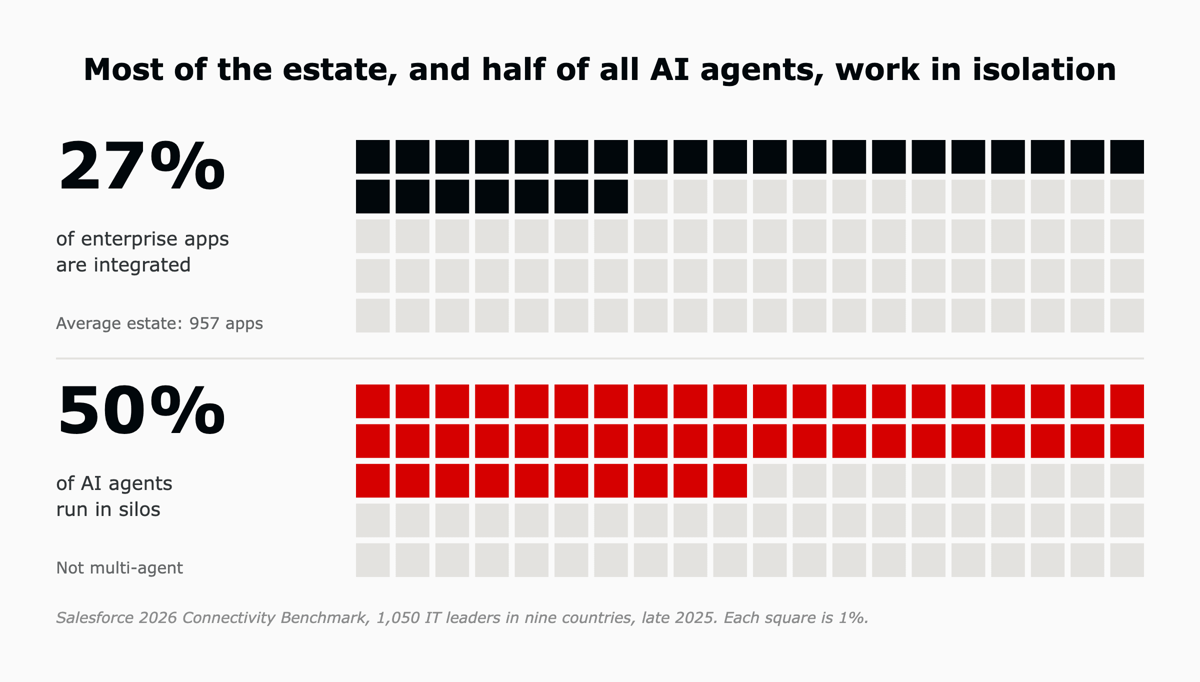
On a service desk, weak integration looks like swivel-chair work. A retailer we spoke with routes calls across two telephony platforms and an AI layer, so a transferred call has to go back and forth between them. Every hop drops context, and an AI agent loses the thread with it.
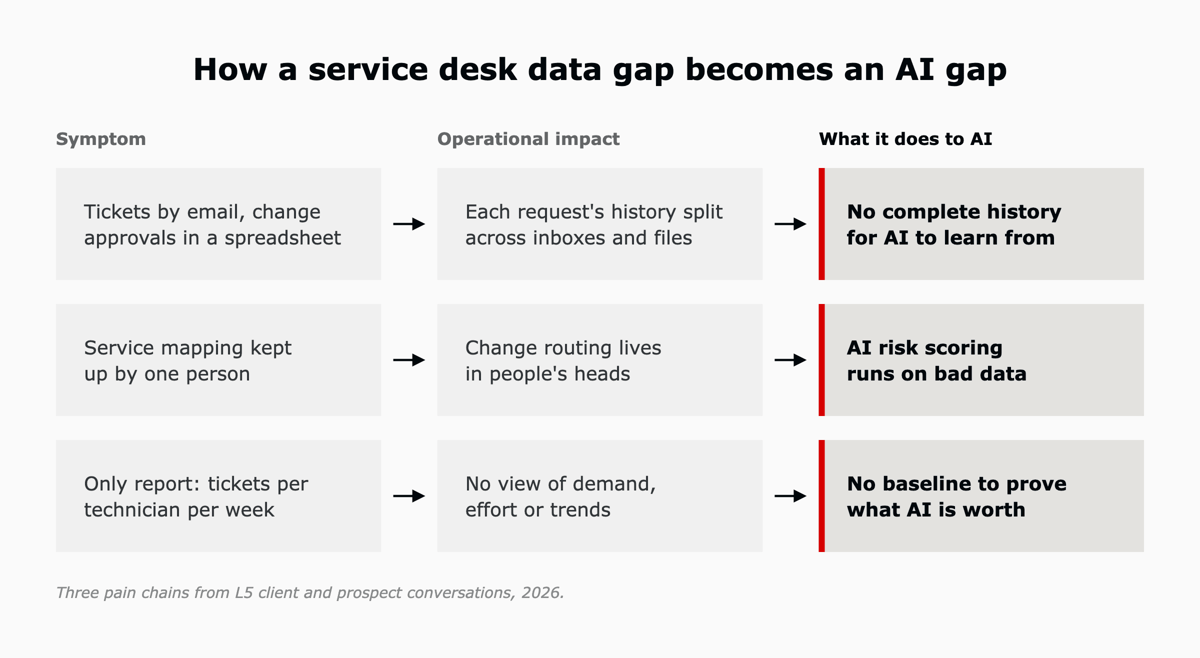
Gartner found that 63% of organizations lack, or are unsure they have, the right data management practices for AI, and predicts organizations will abandon 60% of AI projects unsupported by AI-ready data through 2026. Inside service desks the gaps are specific: configuration data nobody trusts, routing rules that live in people's heads, and reporting that stops at ticket counts.
"It's fully tribal knowledge at this point."
A financial services client
In Why enterprise AI stalls, we separated three modes. Automation runs a script, a copilot recommends while a person executes, and autonomous AI carries a request through to a verified outcome. The service stack underneath decides which of those modes you can actually reach.
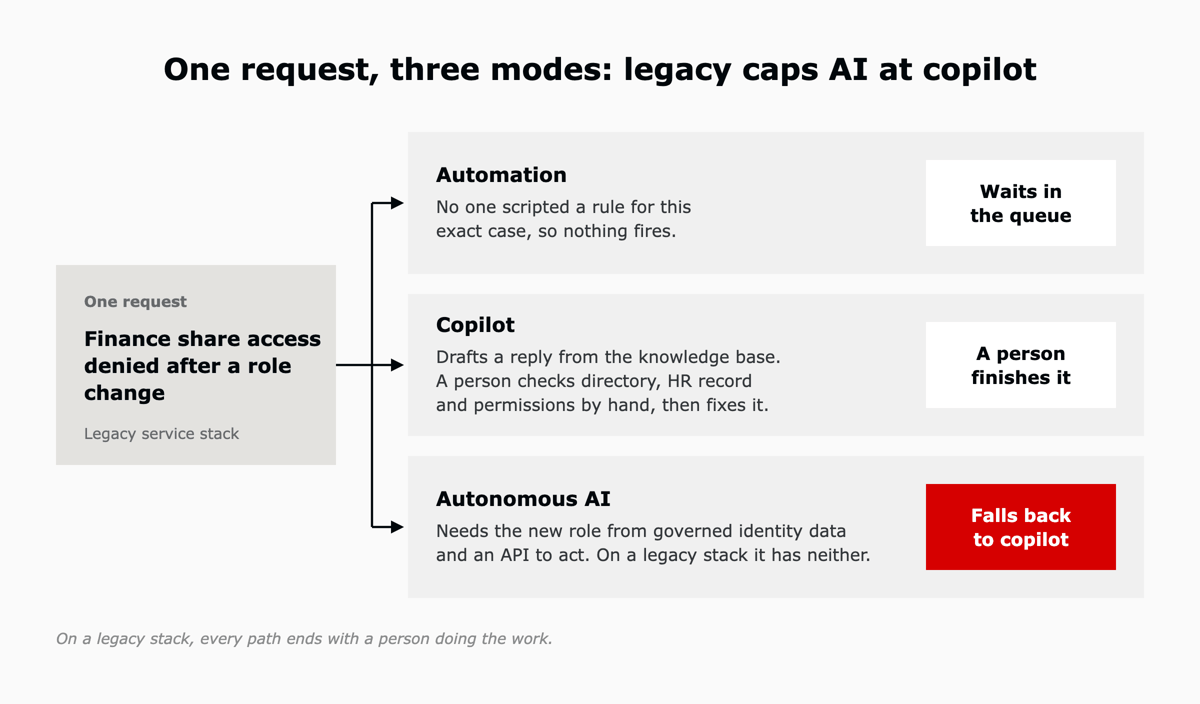
Autonomous AI needs four controls from the platform underneath it: a defined job, governed data, guardrails on action, and a resolution loop. A legacy service tool rarely supplies them, so even a product marketed as autonomous ends up drafting replies for a person to execute.
| Control | What AI needs from the platform | Typical legacy service tool |
|---|---|---|
| Defined job | Request types with owners, SLAs and a clear definition of resolved. | Partial: email threads and loose categories. |
| Governed data | Identity, device and CMDB records the AI can query and trust. | Missing: a stale CMDB and tribal knowledge. |
| Guardrails on action | APIs, permissions and approval paths for bounded actions. | Missing: opaque APIs and change orders anyone can edit. |
| Resolution loop | Workflow state, confirmation with the person, and a full audit trail. | Partial: tickets close and outcomes go unverified. |
Deloitte reaches the same diagnosis: agents need connected environments, legacy infrastructure is often rigid, and the fix is platform modernization, API-driven integration and process re-engineering. Gartner expects over 40% of agentic AI projects to be canceled by the end of 2027 because of escalating costs, unclear business value or inadequate risk controls. Legacy feeds all three: integration glue drives cost, missing reporting hides value, and editable records undermine controls.
The most common reason is that nothing looks broken. Among companies still using legacy systems, half have held off on modernizing because the current system still works.
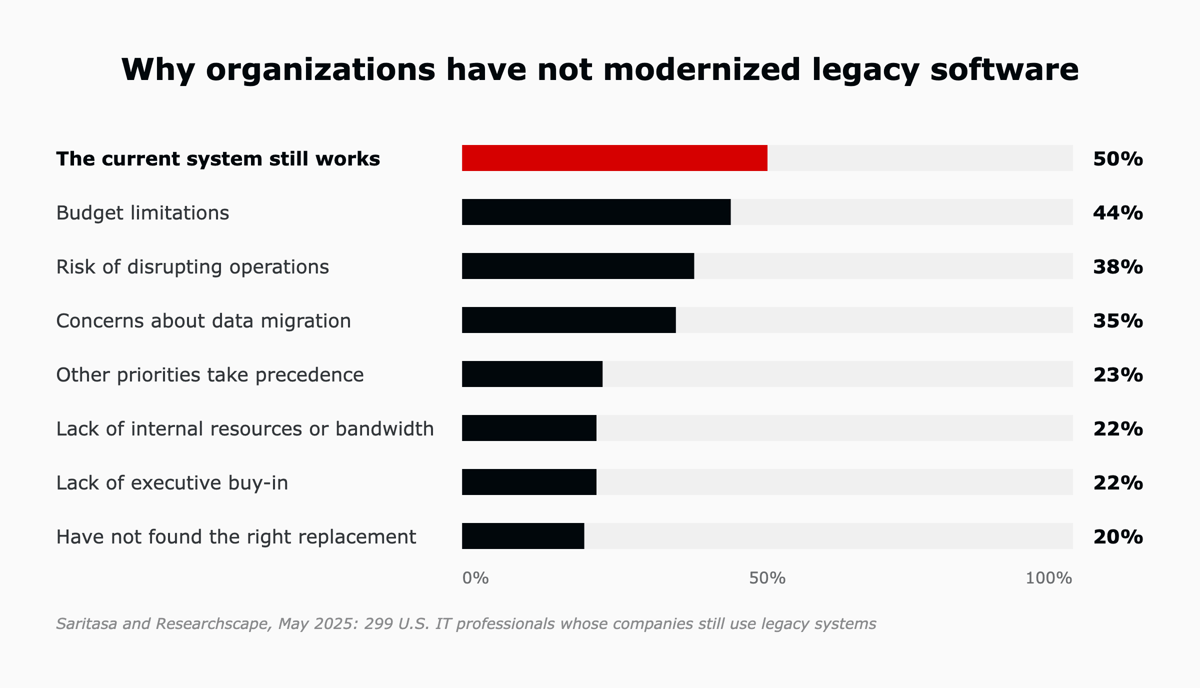
A tool can keep tickets flowing for five more years and still give an AI agent nothing to act on, connect to or learn from. In a 2024 survey by Morning Consult and Unqork, 85% of business and technology leaders said time spent maintaining legacy systems hampers their ability to launch new solutions.
"They want a new coat of paint. They don't want someone to come in and take walls down."
A media client
For 2027 planning, the useful question is whether AI can work with the system, and "it still works" does not answer it.
Fix the foundation in phases, then add AI. The work starts with choosing the route, because not every estate should move, and an honest assessment has to be willing to recommend any of four routes. One of our healthcare clients kept its clinical records system and modernized the service layer around it.
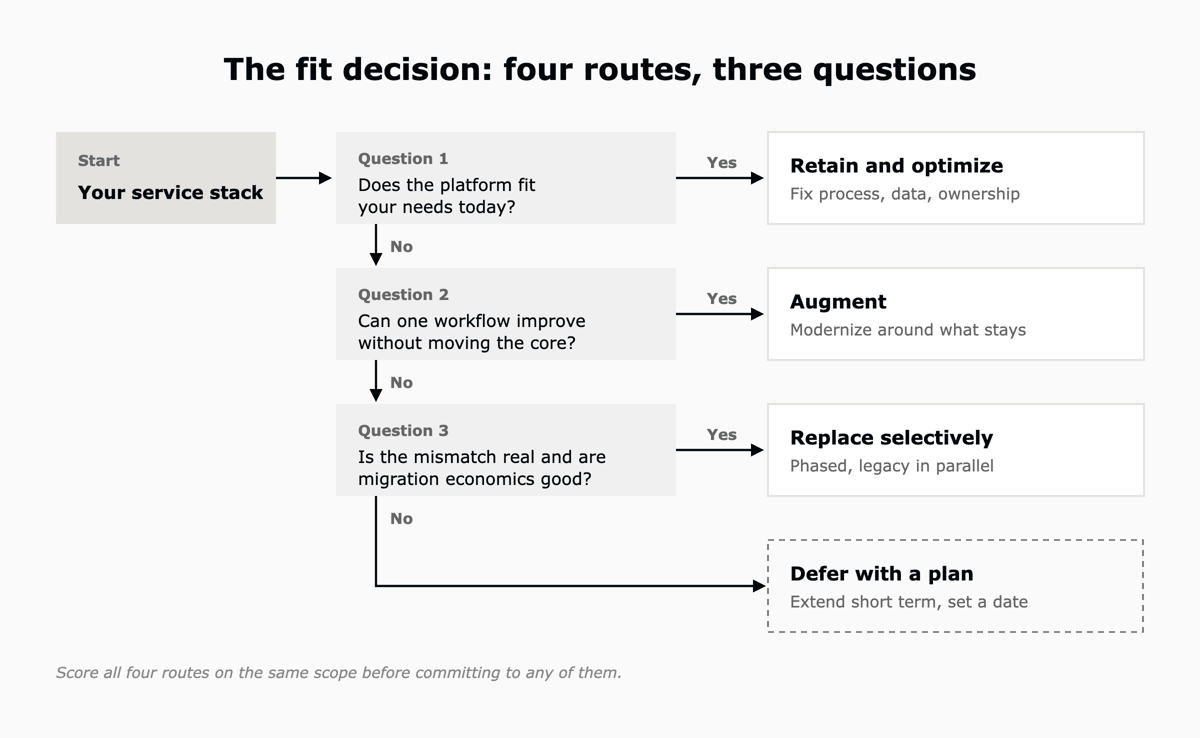
Once the route is clear, sequence the work so AI arrives last, on a foundation that can support it.
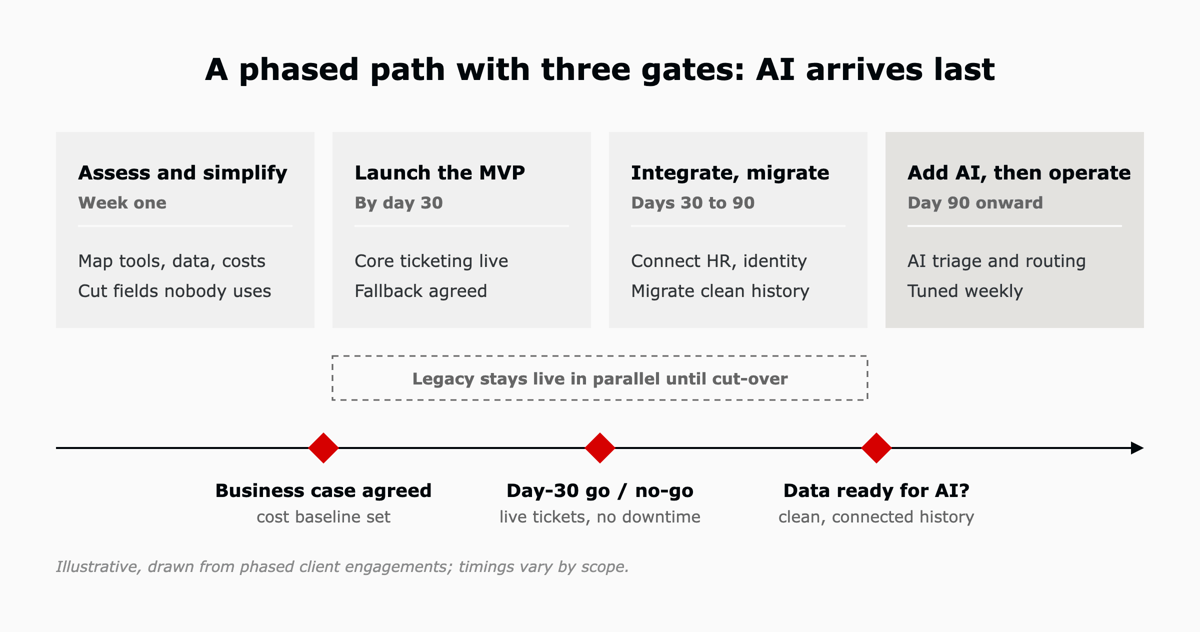
Run legacy in parallel. Keep the old system live and move in stages, with a go or no-go gate at day 30. In our recent client conversations, a phased or parallel rollout has been the consistent preference over a single cut-over.
Simplify before you migrate. Migration is the one moment to drop what legacy accumulated: unused fields, custom change types, and 45-minute forms for two-minute builds.
Decide on data early. Choose what to migrate, archive or rebuild before the build begins. Clean history is the training set your AI will learn from.
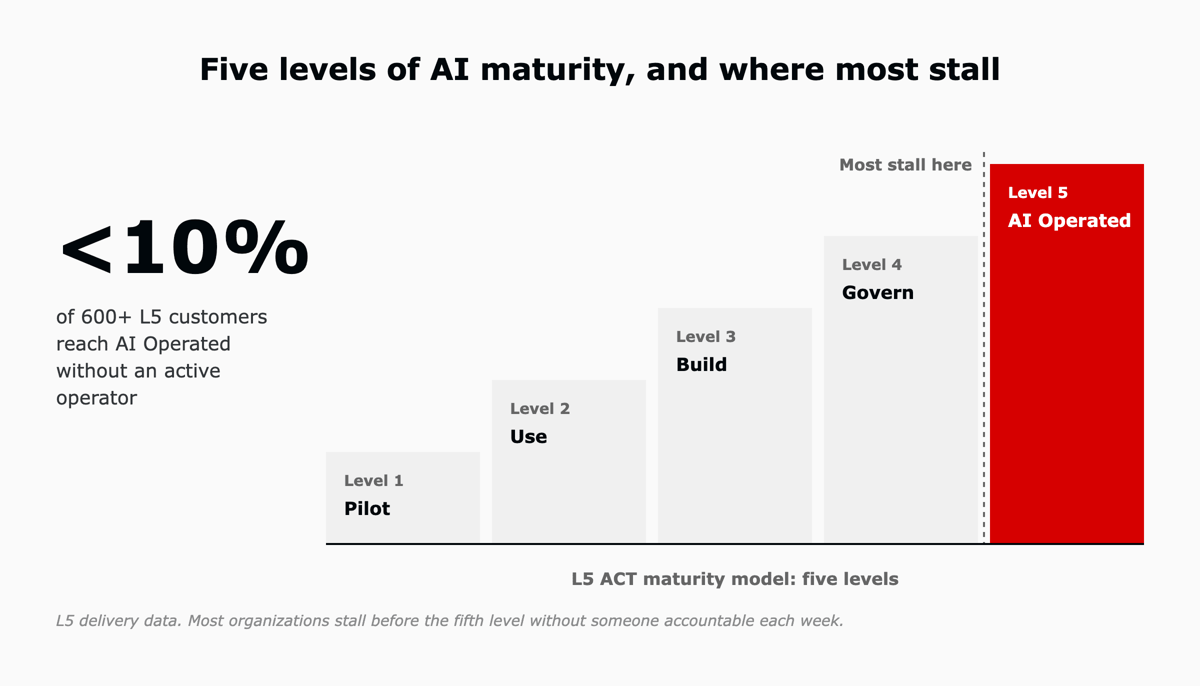
An owner. Go-live fixes the foundation, and keeping it fixed is ongoing work: models drift, knowledge ages and policies change, so guardrails need updating with them. Fewer than 10% of L5's 600+ customers reach Operated, the fifth level of AI maturity, without an active operator.
Once the foundation is in place, the unit of value changes. A closed ticket is an administrative event, while a resolution is an outcome confirmed with the person it affected. Three metrics, from Why enterprise AI stalls, show whether AI is paying off, and none of them can be measured while reporting stops at tickets per technician per week.
| Metric | What it measures | How it is clocked |
|---|---|---|
| Time to productive | How long until the person is working again, across every system the request touched. | Starts at the request and stops when the person is confirmed working. |
| Reopen rate | Whether a resolution actually held. | The share of resolved requests that come back within a set window, such as seven days. |
| Autonomous resolution rate | How much of the routine queue AI finishes end to end. | Eligible requests resolved and verified without a person, by request type. |
Two questions predict where AI will stall: can it reach across your systems, and can it trust what it finds? Plot your service layer on both, then fix the weaker axis first.
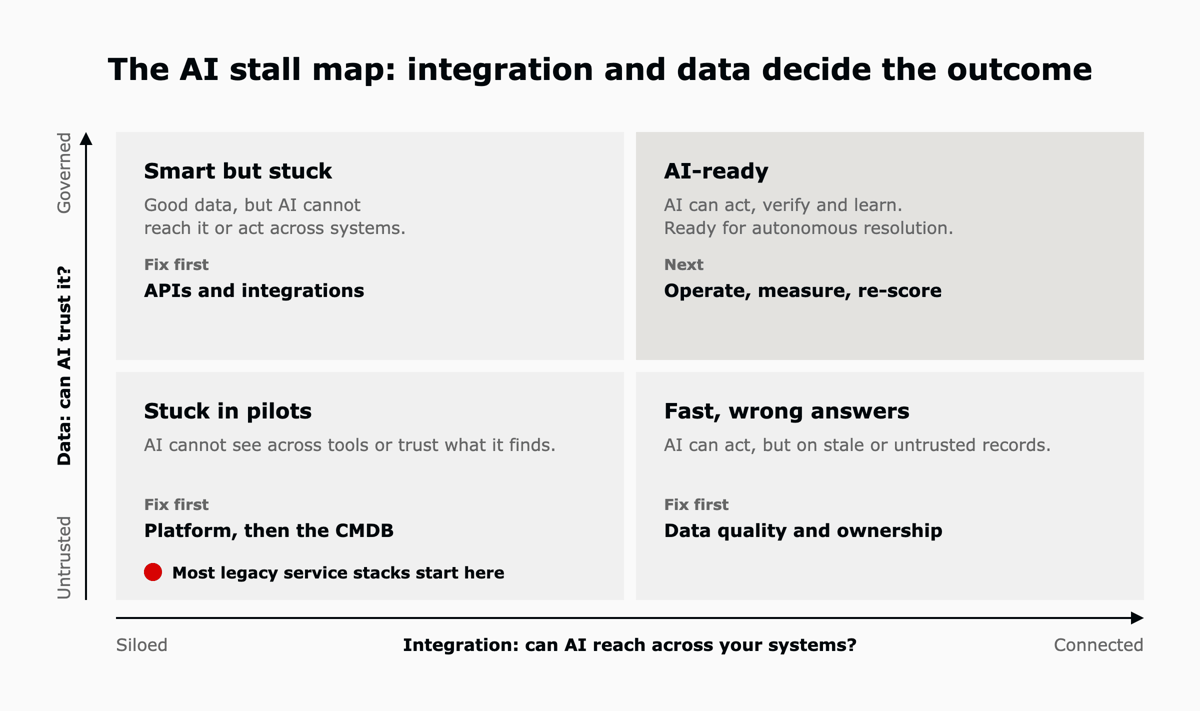
Use these seven questions to place yourself on the map. If three or more answers land in the middle column, AI will inherit your legacy problems instead of solving them.
| Question | Legacy warning sign | AI-ready signal |
|---|---|---|
| Can an AI agent take action? | No usable API; changes made by hand. | Documented APIs for tickets, changes and access. |
| Can it see the whole request? | Email, spreadsheets, phone and several tools. | One platform linked to HR, identity and telephony. |
| Is there history to learn from? | History capped, purged or unstructured. | Years of clean, categorized tickets. |
| Is configuration data trusted? | A CMDB nobody believes. | A maintained CMDB with named owners. |
| Can you measure a baseline? | Reporting stops at ticket counts. | Resolution time, reopen rate and cost tracked. |
| Is it auditable? | Change records editable after the fact. | Enforced approvals and a full audit trail. |
| Does someone own outcomes? | The implementer left at go-live. | A named operator, re-scored quarterly. |
The organizations that get real value from AI in 2027 will be the ones that fixed the foundation first: platforms AI can act through, integrations that give it the whole request, and clean history it can learn from. That takes the right order, a phased plan, the discipline to simplify, and someone who stays accountable after go-live.
AI needs to act through APIs, see requests across systems and learn from clean history. Legacy tools weaken all three, so AI either cannot act or acts on bad data.
Sometimes. If the platform fits and the gap is process or data, optimize or augment it. Replace selectively when integration and data gaps cannot be fixed in place.
The data and integrations AI depends on: trusted configuration data, connected identity and HR records, and categorized ticket history.
No. Mid-market teams often feel it more, because a few admins hold the knowledge and there is little budget for integration glue. They can also move faster, because a focused, phased move is measured in weeks rather than quarters.
Core ticketing can go live in about 30 days, with integrations, migration and AI following in later phases while legacy runs in parallel.
Book an assessment and walk away with a scorecard across five levels of AI maturity, a roadmap and a business case, in one week against a fixed scope. The scorecard shows which of the four controls your stack already supports and which are missing. L5 deploys and operates AI on Zendesk, ClickUp and Workday for mid-market organizations, and stays accountable for what it produces after go-live.

The full article with its figures, tables and sources, set for reading offline, printing, and sharing.
On its way to your inbox You can also download it right now.
Download the PDF Last updatedKeep reading
Part of a series. Why enterprise AI stalls is one article drawn from the L5 whitepaper on how people and AI resolve toge...
Read
Part of a series. This article is drawn from the L5 whitepaper on modernizing IT service management, and looks at the mo...
Read
Part of a series. This article is drawn from the L5 whitepaper on how people and AI resolve together, and looks at the l...
ReadField notes on AI operations and service management, direct to your inbox. New insights, the week we publish them.
No spam. Unsubscribe any time.